
Key Takeaways
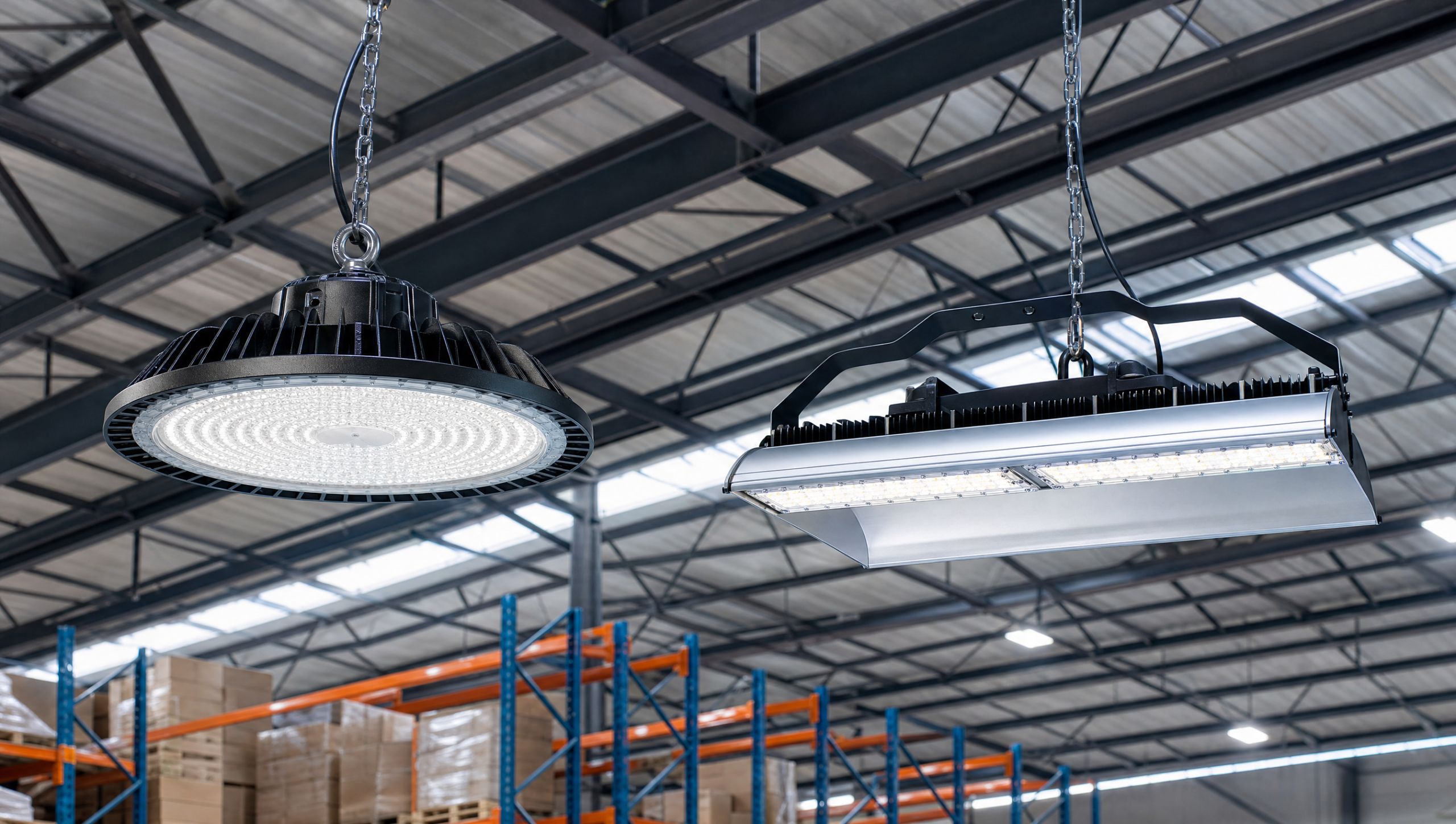
Picking the right LED high bay lights for warehouse work comes down to ceiling height, lumens per square foot, certifications, and warranty. The shortlist below covers what matters before you order pallets of fixtures.
- Energy savings of 60 to 75 percent are typical when LED high bay lights replace metal halide or fluorescent fixtures, per DOE Better Buildings Solution Center.
- 150 to 170 lumens per watt is the 2026 efficacy range for mainstream and premium fixtures, with DLC Premium models hitting the upper band.
- 20 to 30 footcandles covers most storage aisles, per the IES Lighting Library; picking and packing zones jump to 30 to 50.
- Payback of 1.5 to 3 years is normal for two-shift warehouses on 4,000 to 6,000 annual operating hours.
- 5-year standard warranty is the minimum spec for warehouse-grade LED high bays, with extended warranties available on industrial product lines.
Why LED High Bay Lights Replaced Metal Halide in Warehouses
LED high bay lights for warehouse use deliver 60 to 75 percent lower wattage than metal halide or fluorescent fixtures while producing equal or better lumen output, per the DOE Better Buildings high bay fact sheet. Warehouses on multi-shift schedules see annual energy savings that pay back the retrofit in under three years. Maintenance drops in parallel. LEDs last 5 to 10 times longer than metal halide, eliminating the lift-truck callouts that ate into facility budgets for decades.
The retrofit math is simple. A 400W metal halide fixture pulled around 460W at the meter with ballast losses. A modern 200W LED high bay delivers similar foot-candle output at less than half the wattage. Multiply that across 80 fixtures in a 60,000-square-foot warehouse running two shifts, and the energy delta runs into five figures annually.
During our facility tour at First State Fleet Service in New Castle, Delaware in March 2026, the maintenance lead noted that the previous metal halide bank required relamping roughly twice a year due to lumen depreciation. The LED replacement is now rated for 50,000 hours of L70 service. That changes the entire maintenance contract.
Beyond this, light quality matters. Warehouse workers performing visual inspection benefit from higher CRI fixtures (80+) at a 5000K color temperature. As a result, picking accuracy improves and accidents tied to poor visibility drop, a pattern the OSHA general industry walking-working surfaces standard ties directly to safe workspace illumination.
UFO vs Linear LED High Bay for Warehouse Layouts
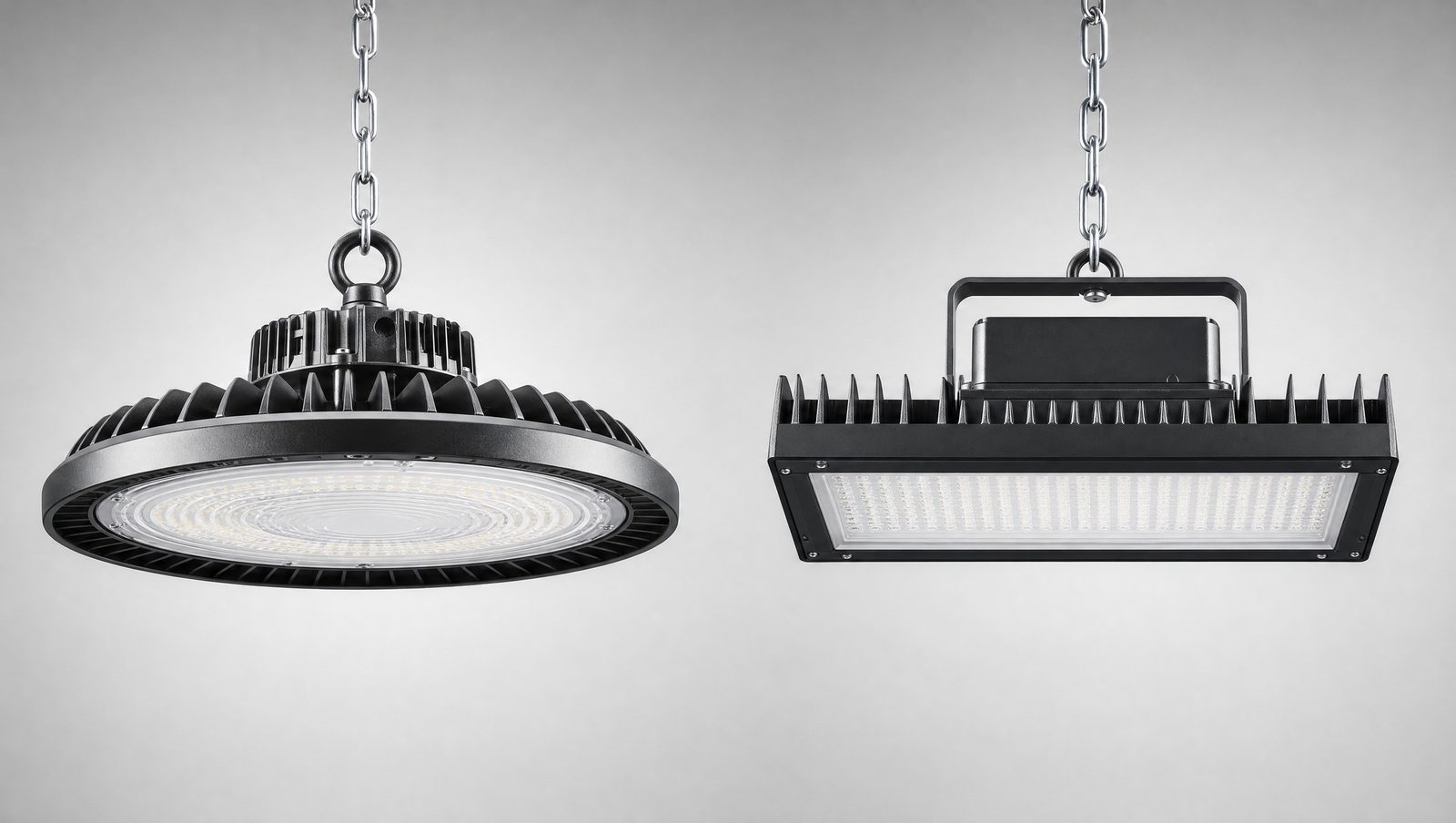
UFO round high bays fit open-floor warehouses with square fixture grids and 20 to 45 foot ceilings. Linear high bays fit narrow aisles between tall pallet racks, where the rectangular light distribution matches the aisle geometry. The choice is dictated by rack layout, not personal preference.
When UFO Round High Bays Win
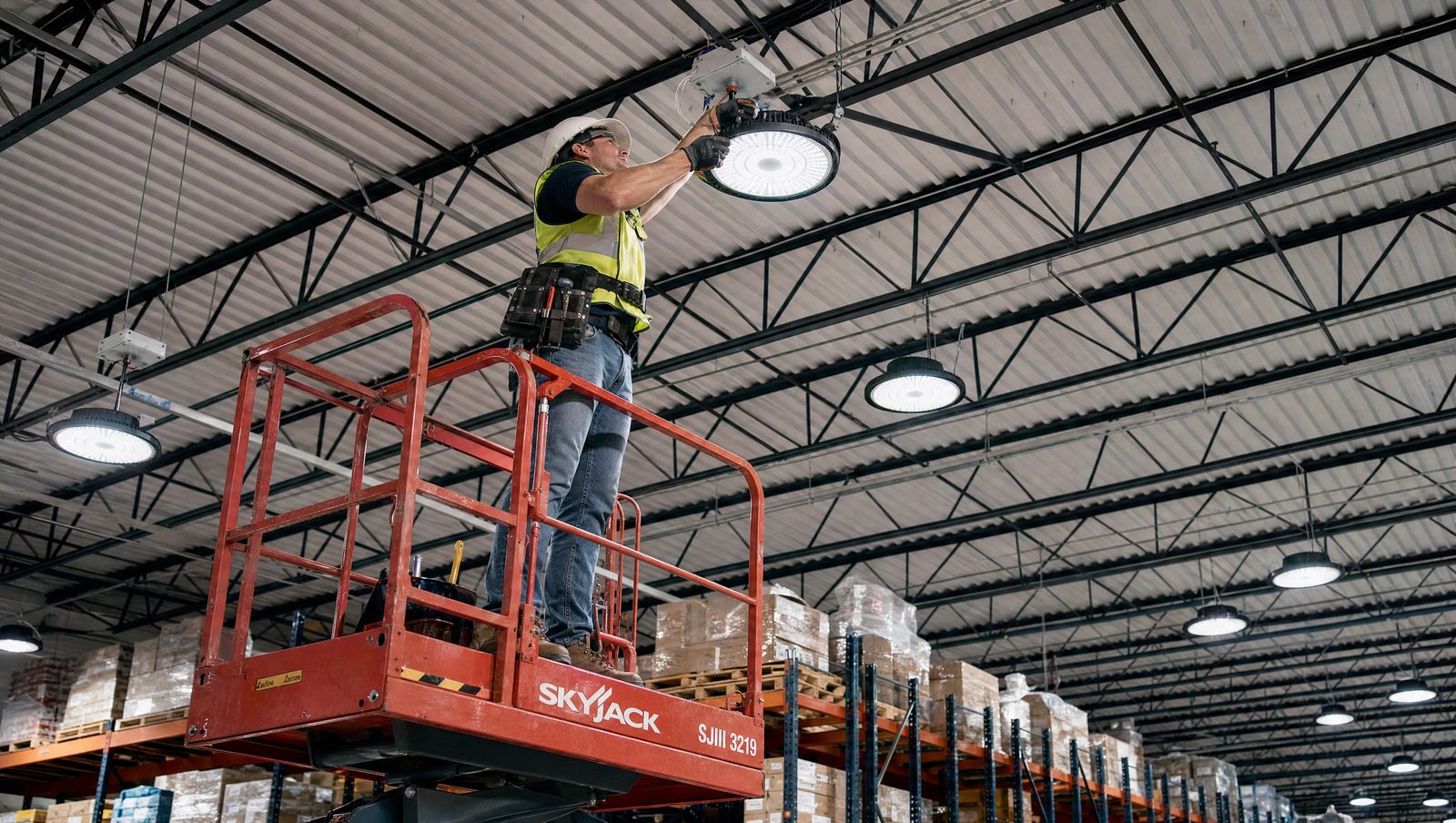
Open floor plate. Production lines. Gymnasium-style storage. UFO fixtures from the LIBULBS EVERLUX round high bay line produce up to 160 lumens per watt with a 120-degree beam angle. They mount on a hook or pendant, are quick to install, and ship light enough that an electrician on a scissor lift can hang 20 fixtures in a shift.
When Linear High Bays Win
Aisles between tall pallet racks. Picking and packing lanes. Loading dock corridors. A linear fixture pushes light along the aisle floor and up the rack faces, where UFO fixtures would either over-light the rack tops or leave dark patches at floor level. Most e-commerce fulfillment centers we have visited use a hybrid layout: linear in the racks, UFO in the staging zones.
Beam Angle and Reflector Choice
Beam angles of 90 to 120 degrees suit ceilings under 30 feet. For ceilings above 35 feet, drop to a 60 to 90 degree beam so the lumens reach the floor before scattering. The wider the beam, the further apart the fixtures can spread, which lowers the total fixture count and the total install cost.
Wattage and Lumens by Ceiling Height
Match wattage to mounting height first, lumens second. A 100W LED high bay producing 15,000 lumens covers a 12-foot ceiling easily but loses footcandle density above 25 feet. A 240W LED high bay producing 36,000 lumens is overkill for a residential workshop but standard for a 35-foot pallet rack warehouse.
The Wattage Cheat Sheet
| Ceiling Height | Typical Wattage | Target Lumens | Fixture Style |
|---|---|---|---|
| 12 to 18 ft | 80W to 100W | 12,000 to 16,000 | UFO or short linear |
| 18 to 25 ft | 100W to 150W | 15,000 to 24,000 | UFO |
| 25 to 35 ft | 150W to 240W | 22,000 to 36,000 | UFO or linear |
| 35 to 45 ft | 240W to 400W | 36,000 to 60,000 | Linear with narrow beam |
The 200W LED high bay buying guide covers the most common warehouse retrofit wattage in detail. For sizing context against other wattages, the 200W specs and performance comparison walks through lumen output and beam options.
Why Efficacy Beats Raw Wattage
Specifically, 200W at 160 lpw produces 32,000 lumens. 240W at 130 lpw produces 31,200 lumens. The lower-wattage fixture wins on the energy bill and the rebate calculation. Efficacy is the metric utility programs care about. Source the spec sheet for tested lumens per watt under LM-79 conditions, not marketing numbers.
Footcandle Targets by Warehouse Zone
Different zones need different footcandle levels. The Illuminating Engineering Society lighting library is the standard reference. Storage aisles need less light than inspection bays. Loading docks need the same as picking, plus emergency egress lighting. Here are the practical numbers warehouse spec engineers work from.
| Warehouse Zone | Target Footcandles | Lumens per Sq Ft |
|---|---|---|
| Bulk storage, low activity | 10 to 20 | 20 to 30 |
| Picking and packing | 20 to 30 | 30 to 50 |
| Inspection and quality control | 30 to 50 | 50 to 75 |
| Loading dock interior | 20 to 30 | 30 to 50 |
| Office and break areas | 30 to 50 | 50 to 75 |
Furthermore, OSHA sets the floor at 5 footcandles for general warehouse spaces in 29 CFR 1926.56, but that is a safety minimum, not a productivity target. Productive warehouses run two to four times the OSHA minimum in active work zones.
Spacing and Layout Rules for LED High Bay Lights for Warehouse
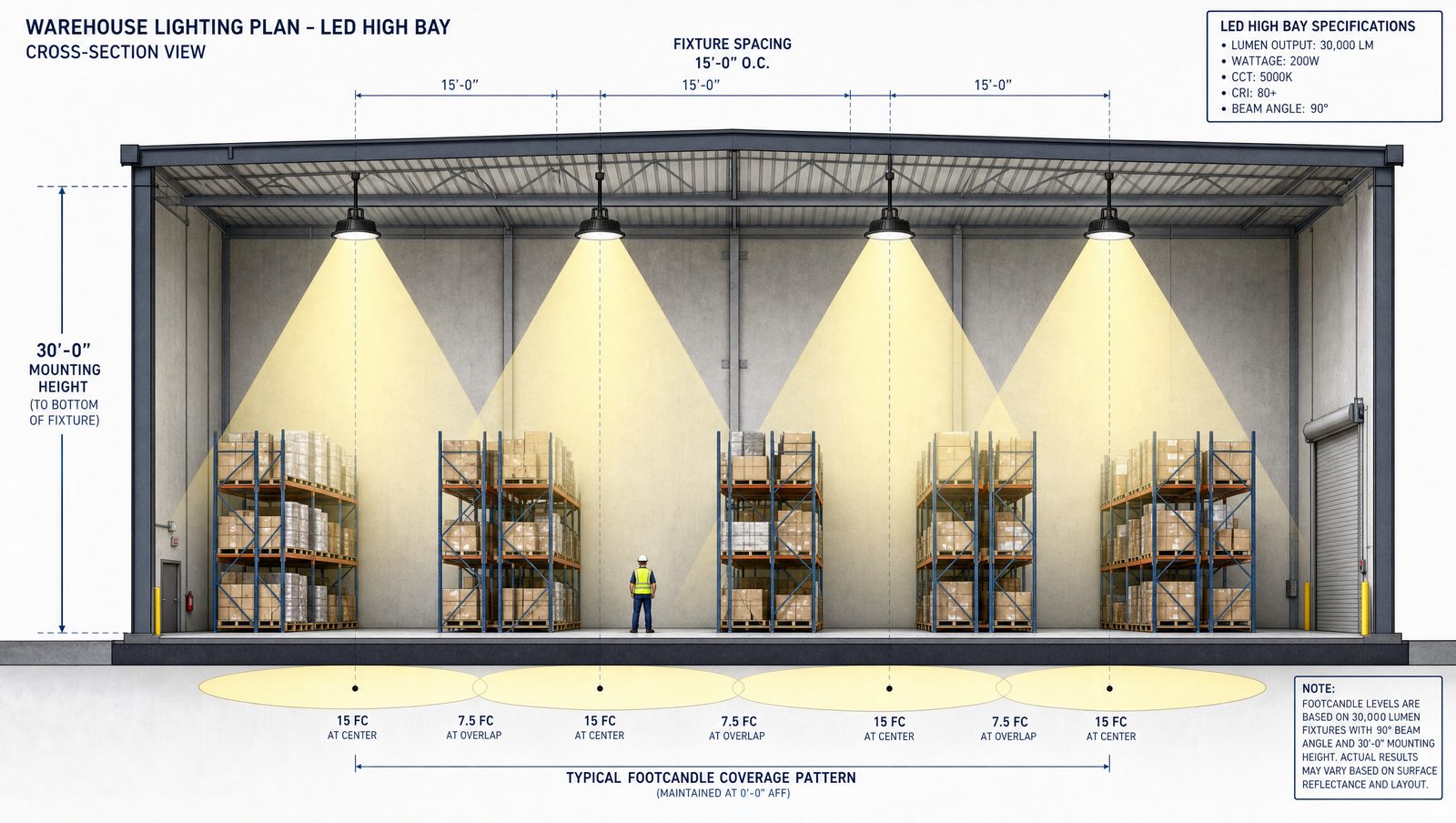
Use a spacing-to-height ratio (SHR) of 1.0 to 1.5 for even illumination. SHR is the distance between fixtures divided by mounting height above the work plane. At 30-foot ceilings, that puts fixtures 30 to 45 feet apart on center. Above 1.5, dark patches show up between fixtures. Below 1.0 wastes capital on over-lighting.
Calculating Fixture Count
The shortcut: multiply floor area by target lumens per square foot, then divide by fixture lumen output. For a 60,000 sq ft warehouse storage zone targeting 30 lumens per square foot, that is 1,800,000 lumens total. Divide by 30,000 lumens per fixture and you need 60 fixtures. Round up for light loss factor (LLF) of 0.85 and you order 70.
Aisle vs Open Floor Layouts
Open floor plans use a square grid. Aisle layouts use linear runs centered between rack rows. To understand aisle layouts, our team observed the Acorn Recognition production floor retrofit in November 2025, where the engineer specified linear high bays running parallel to the production line at 20-foot spacing. The result was even shadow-free task lighting at every workstation.
Pre-Layout Lighting Plan
Most utility rebate programs require a stamped lighting plan from a licensed electrical engineer or lighting designer. Software such as AGi32 or DIALux runs photometric simulations from the IES files supplied by the fixture manufacturer. Ask for the IES file before you place a bulk order. It is the difference between a clean rebate application and a project delay.
DLC Certification and Utility Rebate Eligibility
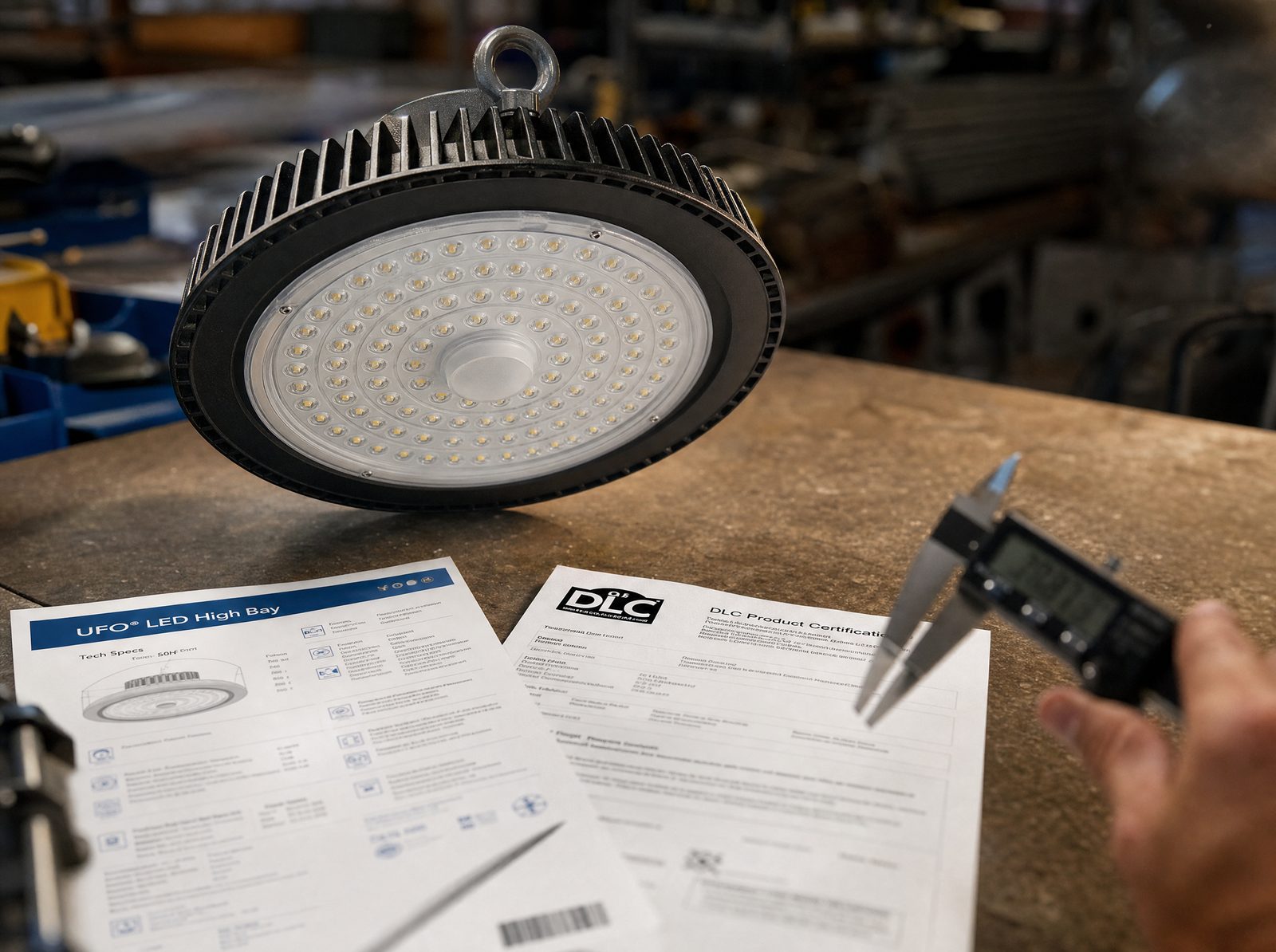
The DesignLights Consortium Qualified Products List is the gatekeeper for nearly every commercial lighting rebate in the United States and Canada. Utilities check the specific fixture model number against the QPL before approving rebates. If the SKU is not listed, the rebate does not pay.
DLC Standard vs DLC Premium
DLC Premium fixtures hit higher efficacy thresholds and unlock rebate amounts 20 to 50 percent larger than DLC Standard models. For a 100-fixture project, the rebate delta can cover the freight cost twice over. Always check both tiers before locking in the spec.
UL and ETL Listings
UL or ETL safety listings are non-negotiable for commercial installations. Inspectors will flag any unlisted fixture during the final electrical inspection. The label has to be visible on the fixture housing, not just on the spec sheet.
State and Utility Programs
Programs vary by state and utility. ENERGY STAR directories list active commercial programs. National accounts can sometimes pool rebates across multiple sites under a single agreement, which simplifies the paperwork on multi-site retrofits.
Sensors, Dimming, and Smart Lighting Controls
Motion sensors and daylight harvesting controls cut warehouse lighting energy by another 30 to 60 percent on top of the LED retrofit savings, per ACEEE field studies. Most modern fixtures support 0-10V dimming as standard. PIR or microwave sensors integrate directly into the fixture housing.
Microwave vs PIR Sensors
Microwave sensors detect movement through racking and can cover an 8 to 12 meter radius. PIR sensors are cheaper but require line-of-sight to the moving target. For warehouse aisles between tall racks, microwave wins almost every time.
Daylight Harvesting
Warehouses with skylights or clerestory windows benefit from daylight sensors that dim fixtures based on ambient light. Loading dock zones with open bay doors during shifts are prime candidates. Daylight control on its own can cut perimeter zone energy by another 20 to 40 percent.
Networked vs Standalone Controls
Standalone fixture-level sensors are simpler to commission and harder to break. Networked controls (DALI, Bluetooth mesh, or wired DMX) enable group scheduling and energy reporting but add complexity. For most distributor and contractor projects, standalone sensors are the right call. For corporate facility chains running energy dashboards, networked controls earn their keep.
Cold Storage, Food Processing, and Wet Environments
Standard LED high bay lights for warehouse dry storage will not survive cold storage, food processing, or wash-down environments. Cold storage drivers fail when temperatures swing below the rated operating range. Food processing zones require IP65 sealing against condensation. Wash-down rated fixtures need IP69K and corrosion-resistant housings.
What stands out in cold storage retrofits is driver placement. Remote drivers in a warmer mechanical room outperform integrated drivers when ambient temperatures drop below 0 degrees Fahrenheit. The fixture warranty often hinges on this detail. Read the spec sheet carefully before ordering.
IP Ratings Decoded
IP65 means dust-tight and protected against low-pressure water jets. IP66 adds high-pressure water resistance. IP67 adds short-duration immersion. IP69K rates the fixture for high-pressure, high-temperature wash-down typical in food processing. Match the rating to the actual environmental exposure, not the marketing brochure.
Cost, ROI, and Total Cost of Ownership
The 60 to 75 percent energy savings is the headline number, but maintenance and rebate savings often deliver more bottom-line impact. A 50,000 hour rated LED high bay replaces 5 to 10 metal halide lamp cycles. Each lamp swap on a 30-foot ceiling typically runs $150 to $300 in labor and equipment rental. That avoidance compounds over the fixture life.
Sample 60,000 Square Foot Warehouse Math
| Line Item | Before (400W MH) | After (200W LED) |
|---|---|---|
| Fixture count | 80 | 80 |
| Connected load | 36.8 kW | 16.0 kW |
| Annual hours (2 shifts) | 5,000 | 5,000 |
| Annual kWh | 184,000 | 80,000 |
| Annual energy cost (at $0.13/kWh) | $23,920 | $10,400 |
| Annual maintenance estimate | $6,400 | $640 |
| Annual total cost | $30,320 | $11,040 |
Specifically, the swing is $19,280 per year before rebates. With a typical $80 per fixture utility rebate, the upfront capital drops by $6,400. Payback at this scale runs 1.5 to 2.5 years on most retrofit projects. For 24/7 facilities, payback dips below 12 months. The numbers track with what U.S. Energy Information Administration reports on commercial electricity costs.
Hidden Costs to Account For
Disposal of mercury-bearing metal halide and HID lamps requires hazardous waste handling in most states. Demolition and disposal often runs $5 to $15 per fixture. Add scaffolding or scissor lift rental if your maintenance crew does not own the equipment. As a result, your total project cost should include 10 to 15 percent contingency for these items.
Sourcing, Lead Times, and Warranty
The right LED high bay light for warehouse use is the one that ships when the project needs it, with a warranty that actually pays out. Stock depth, freight terms, and warranty service drive the success of every retrofit project we have seen.
Stock Depth Beats Catalog Depth
A catalog of 500 SKUs is worthless if the four you need are on a 12-week container from Asia. Ask any wholesale supplier for current stock counts before you specify. LIBULBS ships same-day on in-stock items from the Delaware warehouse, with next-day delivery in the NYC metro area covering Queens, Brooklyn, Manhattan, and northern New Jersey.
Warranty Terms That Matter
5-year standard warranty is the minimum benchmark for warehouse-grade high bays. Extended warranties on industrial and pole lighting product lines run 7 years. Read the warranty wording before signing the PO. Some manufacturers issue replacement product only. Others issue credit notes against future orders. The cash impact of a failed driver three years in differs by an order of magnitude depending on which approach the manufacturer uses.
Distributor Programs and MAP Protection
For distributors quoting high bay projects, MAP enforcement protects the bid from online undercutting. LIBULBS operates under written Minimum Retail Pricing policy with territorial exclusivity for trade partners. See the MAP enforcement guide and the distributor margin breakdown for the policy mechanics. New distributors can start with the distributor program overview.
Based on our consultation with the Acorn Recognition facility team in late 2025, the spec was driven less by upfront fixture cost and more by warranty clarity and lead time. Most contractors we work with weight the same way. Specifically, the bid wins on the warranty terms, the energy savings projection, and the delivery commitment. Price comes third.
Spec a warehouse retrofit with LIBULBS
Trade accounts include written MAP enforcement, same-day shipping on in-stock items, and 5-year standard warranties on the EVERLUX high bay line. Distributor applications take about 3 minutes.
Frequently Asked Questions
How many lumens do LED high bay lights for warehouse need per square foot?
Most warehouse storage zones target 20 to 30 lumens per square foot. Picking and packing areas target 30 to 50. Inspection bays target 50 to 75. Multiply floor area by the target footcandle level, then divide by fixture lumen output to get fixture count.
What wattage LED high bay lights work best at 30-foot warehouse ceilings?
For 28 to 35 foot mounting heights, a 200W to 240W LED high bay producing 28,000 to 36,000 lumens at 150 to 160 lumens per watt is the typical spec. Lower ceilings of 18 to 25 feet usually call for 100W to 150W fixtures.
Are LED high bay lights for warehouse DLC certified for utility rebates?
Most utilities require DLC Standard or DLC Premium qualification on the fixture model number for rebate eligibility. Premium-tier rebates run 20 to 50 percent larger than Standard-tier rebates, per the DesignLights Consortium.
What is the ROI on LED high bay lights for warehouse retrofits?
Single-shift warehouses typically see payback in 2 to 4 years. Two-shift facilities pay back in 1.5 to 3 years. 24/7 operations pay back under 12 months. The drivers are 60 to 75 percent lower wattage versus metal halide and roughly 90 percent lower maintenance cost.
UFO or linear LED high bay, which works better in a warehouse?
UFO round high bays suit open floor and aisle layouts with square fixture grids. Linear high bays distribute light along narrow aisles between tall racks, which is why they dominate fulfillment center spec sheets. Most fulfillment centers combine both styles.
What IP rating should LED high bay lights for warehouse carry?
Standard dry-storage warehouses use IP65 rated fixtures. Cold storage, food processing, and wash-down areas need IP65 or higher with corrosion-resistant housings and condensation-tolerant drivers. Match the IP rating to the actual environmental exposure.
Can LED high bay lights for warehouse work with motion sensors?
Yes. Microwave or PIR sensors integrated into the fixture cut lighting energy by another 30 to 60 percent in low-traffic aisles. Most facility managers pair sensors with daylight harvesting near skylights or loading docks.