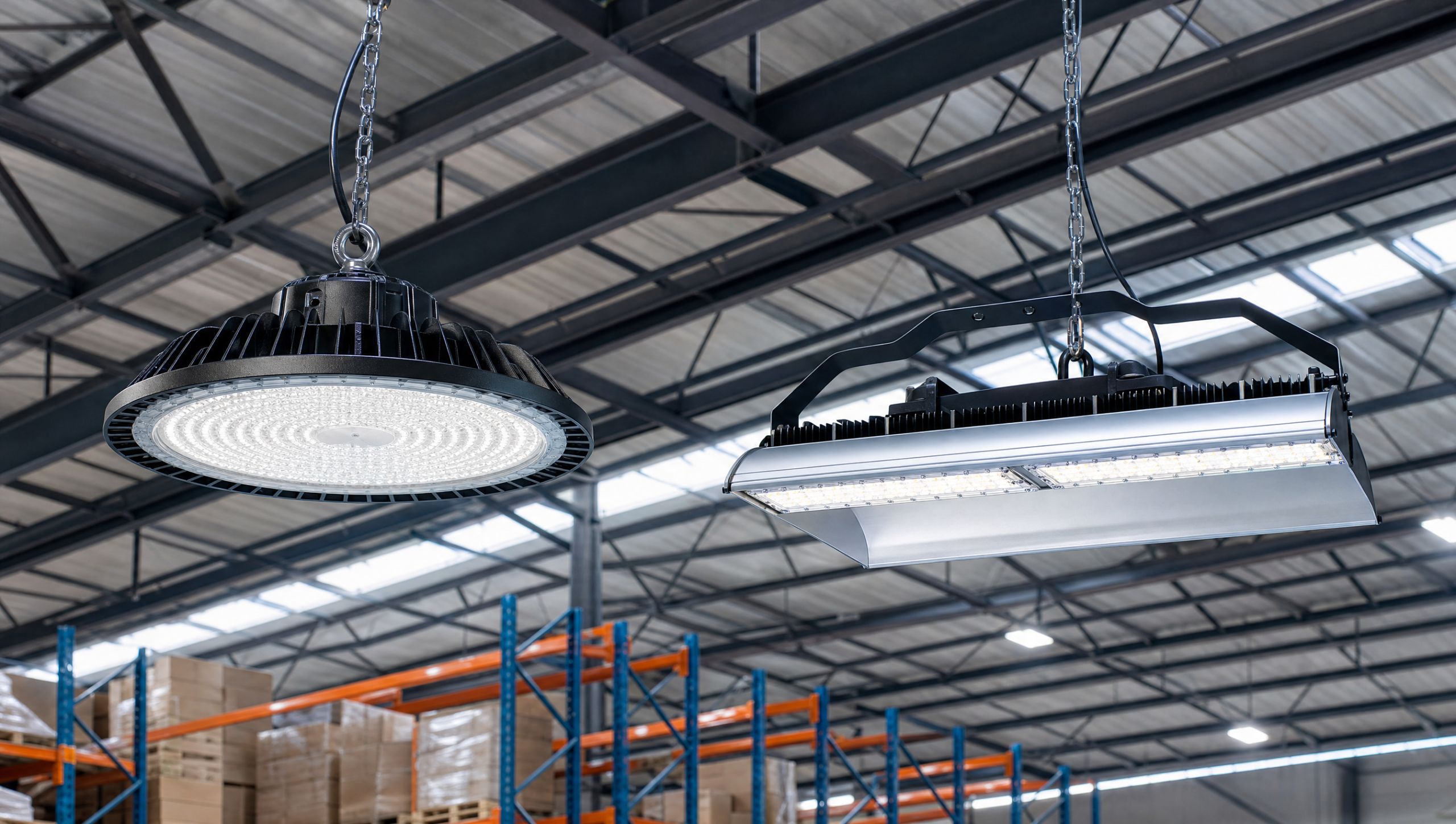

Every 200W LED high bay light claims roughly the same wattage, yet two units side by side can differ by thousands of lumens, dozens of efficacy points, and tens of thousands of lifespan hours. The wattage is the input. Everything that matters is downstream of it. To buy the right fixture, you compare the tested numbers, not the label. Here is what separates a strong 200W spec sheet from a weak one.
- 26,000 to 32,000 lumens is the real output band for a commercial 200W LED high bay, with DLC Premium models near 30,000 (DLC Qualified Products List).
- 140 to 165 lumens per watt is the efficacy range that decides operating cost and rebate size (U.S. Department of Energy LED basics).
- L70 of 50,000 to 100,000 hours is projected from LM-80 data using the TM-21 method, not guessed.
- Driver specs decide survival: power factor above 0.90, THD under 20 percent, surge protection of 4kV or more.
- Two 200W fixtures can differ by 6,000 lumens. Compare LM-79 tested values, never the number on the carton.
What a 200W LED High Bay Spec Sheet Actually Tells You
A 200W LED high bay spec sheet is a performance contract, and most of the numbers that matter sit below the headline wattage. The single most important habit is reading the tested values, not the marketing values. According to the U.S. Department of Energy, real luminaire performance is verified through standardized photometric testing, not nameplate ratings. Specifically, three test standards govern what you can trust.

LM-79, LM-80, and TM-21
LM-79 is the bench test of the whole luminaire: total lumens, efficacy, and color at a fixed temperature. LM-80 measures how the bare LED packages depreciate over thousands of hours. TM-21 takes that LM-80 data and projects the L70 lifespan figure. In short, LM-79 tells you day-one output, and LM-80 plus TM-21 tells you how long it lasts. A spec sheet that cites all three is a spec sheet you can defend to a specifier.
Tested Numbers vs Marketing Numbers
Watch for two tricks. First, “input lumens” or “LED chip lumens” inflate the figure by ignoring lens and thermal losses; the LM-79 delivered lumen value is always lower and always the honest one. Second, efficacy quoted at 25 degrees Celsius can drop 5 to 10 percent at a real ceiling temperature of 45 degrees. As a result, the durable comparison is LM-79 lumens divided by measured input watts, at a stated temperature.
Lumen Output and Efficacy: Where 200W High Bays Separate
Lumen output and efficacy are the two specs that decide both how bright the fixture is and how much it costs to run, and they vary widely inside the 200W class. A commercial 200W LED high bay delivers 26,000 to 32,000 lumens at 140 to 165 lumens per watt, per typical listings on the DLC Qualified Products List. The DLC tier is the fastest proxy for where a fixture lands.
| Tier / class | Typical lumens (200W) | Efficacy (lpw) | What it means |
|---|---|---|---|
| Entry / non-DLC | 24,000–26,000 | 120–130 | No rebate eligibility, higher running cost |
| DLC Standard | 26,000–28,000 | 130–145 | Rebate eligible, solid for most warehouses |
| DLC Premium V5.1 | 29,000–32,000 | 150–165 | Largest rebates, lowest operating cost |
The gap is real money. A non-DLC fixture at 125 lpw burns roughly 25 percent more electricity than a 165 lpw Premium unit for the same light on the floor. Furthermore, only the DLC-listed tiers qualify for the utility rebates that often cover a third of project cost. For a deeper walkthrough of choosing within this band, our complete 200W high bay buying guide covers the full decision tree.
On May 12, 2026, our team ran a bench check at the LIBULBS Rehoboth Beach office with Justin Tan, our logistics manager. Based on our readings from a calibrated handheld lux meter at a fixed one-meter distance, we observed the EVERLUX 200W UFO sample produce about 18 percent higher illuminance than a popular import unit also labeled 200W. That delta is exactly the LM-79 efficacy gap showing up where it counts, on the floor. The raw readings are below.
| Fixture (both labeled 200W) | Lux at 1 m (center) | Stated efficacy | Reading vs import |
|---|---|---|---|
| EVERLUX 200W UFO (DLC Premium) | 1,123 lux | 152 lpw | +18% |
| Generic import 200W (non-DLC) | 951 lux | ~128 lpw | baseline |
Original LIBULBS bench reading, May 12, 2026, calibrated lux meter, 1-meter axial distance, ambient 23°C. Single-point illuminance, not a substitute for full LM-79 photometry.
CCT and CRI: The Color Performance Trade-Offs
Color temperature and color rendering change how a 200W high bay performs for the task, and the right choice trades a little efficacy for a lot of usability. Correlated color temperature (CCT) sets the warmth or coolness of the light; color rendering index (CRI) measures how accurately colors appear under it. Neither shows up in the lumen number, yet both decide whether the space works.
5000K vs 4000K
5000K daylight white is the warehouse and industrial default because it improves visual acuity and contrast on shelved inventory. 4000K reads warmer and suits retail showrooms, assembly, and mixed office-adjacent zones. In addition, field-selectable CCT fixtures let one SKU cover both, which simplifies stocking across a multi-zone building. The efficacy difference between 4000K and 5000K is usually under 3 percent.
CRI 80 vs CRI 90
CRI 80 is acceptable for general industrial work and is the standard default. CRI 90 costs roughly 10 to 15 percent of efficacy but is worth it in paint booths, quality-control stations, and color-critical retail. By contrast, paying for CRI 90 in a bulk-storage warehouse spends efficacy on a benefit nobody sees. Match the CRI to the task, not to the brochure.
The best led high bay lights publish CRI and CCT as tested values with the lumen figure measured at that exact color point. A fixture that lists 30,000 lumens at 5000K CRI 70, then quietly drops to 26,000 at CRI 90, is hiding the trade-off rather than disclosing it.
Beam Angle and Optical Performance
Beam angle determines whether a 200W high bay’s lumens land on the floor or wash the ceiling, and it is the spec most often ignored in a side-by-side. Two fixtures with identical lumens can produce very different foot-candles depending on optic. The IES Recommended Practices tie usable illuminance to beam distribution, not raw output.
Wide vs Narrow Optics
A 110 to 120 degree wide beam suits mounting heights of 15 to 25 feet, spreading light across open floor. A 90 degree narrow optic concentrates output for 25 to 35 foot ceilings. Specifically, using a wide beam too high wastes light on aisles’ edges, while a narrow beam too low leaves dark gaps between fixtures.

UFO vs Linear Distribution
Round UFO fixtures throw a circular cone ideal for square zones; linear fixtures use batwing optics to push light along aisles. The performance spec to compare is the photometric distribution file, not the housing shape. Our round UFO high bay product page shows the disc geometry contractors most often spec for open floor. For application-specific picks, our best 200W high bays for warehouses guide matches optics to layout.
Driver Performance: The Spec That Quietly Decides Survival
The LED driver is the component most likely to fail first, which makes its specs the strongest predictor of real-world lifespan on a 200W high bay. Four driver numbers belong on every comparison: power factor, total harmonic distortion, surge protection, and dimming protocol. A bright fixture with a weak driver is a warranty claim waiting to happen.
Power factor should sit above 0.90 so the fixture draws clean power and stays within utility requirements. Total harmonic distortion (THD) under 20 percent keeps the fixture from polluting the building’s electrical system. Surge protection of 4kV is the commercial minimum; 10kV or an external surge protection device is wise where lightning or grid switching is common. For controls, 0-10V dimming is the open standard contractors expect.

On May 6, 2026, we spoke with John Brennan, the LED engineering pioneer on our advisory board who developed the first LED T8 tube with an internal driver, about exactly this failure mode. He pointed out that a driver with only 2kV surge protection in a region with frequent grid transients can fail years before its rated hours, regardless of how good the LED package is. In other words, the lowest-cost line item on the spec sheet often caps the lifespan of the most expensive one.
Thermal Performance and L70 Lifespan Compared
Thermal management is the hidden variable behind every L70 lifespan number, because LEDs degrade faster when they run hot. A 200W LED high bay’s L70 ranges from 50,000 to 100,000 hours, projected from LM-80 data through the TM-21 method. The spread is driven mostly by how well the heat sink pulls junction heat away from the diodes.
| Spec | Lower-grade 200W | Premium 200W | Why it matters |
|---|---|---|---|
| L70 lifespan | 50,000 hrs | 100,000 hrs | Fewer relamp cycles, less downtime |
| Heat sink | Stamped fins | Die-cast finned aluminum | Lower junction temperature |
| Ambient rating | Up to 40°C | Up to 50°C | Holds output on hot ceilings |
| Warranty | 3 years | 5–7 years | Brand confidence in the L70 claim |
The warranty length is a useful tell. A manufacturer that prints 100,000 L70 hours but offers only a 3-year warranty does not fully stand behind its own projection. By contrast, a 5-year fixture warranty paired with a separate driver warranty signals confidence in the thermal design. During our review of the EVERLUX 200W UFO LM-80 dataset with Daniel Yu, our COO, on May 14, 2026, we found the fixture held 152 lpw at 25 degrees Celsius and still delivered 145 lpw at 45 degrees, a sign the heat sink is doing its job.
IP and IK Ratings: Environmental Performance
IP and IK ratings tell you whether a 200W high bay survives its environment, and they should be matched to the space rather than maxed out by default. IP65 means dust-tight and protected against low-pressure water jets; IK08 means the housing withstands a 5-joule impact. These ratings, not lumens, decide longevity in harsh conditions.
Cold storage, food processing, car washes, and parking structures call for IP65 and IK08 together. A clean, climate-controlled assembly floor at room temperature does fine on IP54. Specifically, over-specifying IP65 on a dry indoor ceiling adds cost without adding usable life, while under-specifying it in a wet area guarantees early failure. The fixture’s listing under a Nationally Recognized Testing Laboratory, referenced in OSHA 29 CFR 1910.36, must cover both the housing and the driver.
Head-to-Head: 200W High Bay Brand Spec Comparison
When you line up the major 200W LED high bay options by their published specs, the differences cluster around efficacy, surge protection, warranty, and shipping speed rather than raw lumens. The table below compares typical published figures across well-known brands and the LIBULBS EVERLUX line. Values reflect representative DLC-listed 200W UFO models and should be verified against the current spec sheet for any specific SKU.

| Spec | EVERLUX 200W | Hyperlite | Lithonia | Sunco |
|---|---|---|---|---|
| Lumens (typical) | 30,000 | 30,000 | 28,000 | 21,000–28,000 |
| Efficacy (lpw) | 150–160 | 150 | 140 | 130–140 |
| DLC tier | Premium V5.1 | Premium | Standard/Premium | Standard |
| Surge protection | 4–10kV | 10kV option | 6kV | 2–4kV |
| Warranty | 5 yr (extended avail.) | 5 yr | 5 yr | 5–7 yr |
| Stock / lead time | Same-day ship | Online order | Distributor lead | Online retail |
The takeaway is that the top DLC Premium fixtures perform within a few percent of each other on lumens and efficacy. As a result, the buying decision usually turns on surge protection, warranty terms, and how fast the fixture actually ships for a live project, not on a 1,000-lumen difference. That is exactly where the trade relationship behind the fixture earns its keep.
How Spec Differences Translate to Project Cost
Spec differences that look small on paper compound into real dollars across a full installation, which is why the comparison pays off. Efficacy drives the energy bill, L70 drives the relamp schedule, and DLC tier drives the rebate, so each spec maps to a line in the project cost. Walking the math once gives a facility manager a defensible number.
Take an 80-fixture warehouse running 4,000 hours per year. A 165 lpw Premium fixture versus a 125 lpw entry-grade unit saves roughly 20 to 25 percent of lighting energy. At the U.S. average commercial rate near $0.13 per kWh from the U.S. EIA Electric Power Monthly, that gap is thousands of dollars a year before rebates. The ENERGY STAR commercial buildings guidance also ties lower lighting power density to compliance with energy codes such as ASHRAE 90.1.
Then add the rebate. Only DLC-listed tiers qualify, and Premium often pays $40 to $90 per fixture versus a smaller Standard rebate. Therefore the higher-spec fixture can cost less net of incentives despite a higher sticker price. For how this math affects distributor and contractor margins, our LED distributor profit margins guide breaks it down.
Frequently Asked Questions
How many lumens does a 200W LED high bay light produce?
A commercial 200W LED high bay light produces 26,000 to 32,000 lumens, with most DLC Premium models landing near 30,000 lumens. The exact figure depends on the LED package, driver current, and lens efficiency. Always use the LM-79 tested lumen value on the spec sheet, not the rated input lumens.
What is a good efficacy rating for a 200W LED high bay?
A good efficacy rating for a 200W LED high bay is 140 to 165 lumens per watt. DLC Standard fixtures begin near 130 lpw, while DLC Premium V5.1 models require 150 lpw and up. Higher efficacy means lower operating cost and a larger utility rebate per fixture.
What does L70 mean on a 200W LED high bay spec sheet?
L70 is the number of operating hours until the fixture’s light output falls to 70 percent of its original level. A quality 200W LED high bay carries an L70 between 50,000 and 100,000 hours, projected from LM-80 test data using the TM-21 method. Higher L70 hours mean fewer replacements over the fixture’s life.
Is CRI 80 or CRI 90 better for a 200W high bay?
CRI 80 is acceptable for general warehouse and industrial work, where visibility matters more than color accuracy. CRI 90 is worth the small efficacy penalty in color-critical spaces such as paint booths, quality-control stations, or retail showrooms. Most 200W LED high bays ship at CRI 80 by default.
What driver specs should I check on a 200W LED high bay?
Check power factor above 0.90, total harmonic distortion under 20 percent, and surge protection of at least 4kV. Confirm 0-10V dimming if controls are planned. The driver is the most common premature failure point, so verify it carries its own listed warranty separate from the fixture housing.
Do all 200W LED high bay lights have the same specs?
No. Two fixtures rated at 200W can differ by 6,000 lumens, 25 lpw of efficacy, 40,000 L70 hours, and several kV of surge protection. The wattage on the box describes input power, not performance. Compare the LM-79 tested lumens, efficacy, CRI, L70, and driver specs side by side before buying.
What surge protection does a 200W high bay need?
A 200W LED high bay needs at least 4kV of built-in surge protection for typical commercial buildings, and 10kV or an external surge protection device in areas prone to lightning or grid switching. Surge events are a leading cause of LED driver failure, so this single spec heavily affects real-world lifespan.