
Disclosure: Published by LIBULBS. Competitor brands named in this guide are direct trade competitors. Sources are linked inline. Editorial questions go to support@libulbs.com.
A 200W LED high bay light is the workhorse fixture for ceilings between 15 and 35 feet. The wattage band is busy with options, the spec sheets blur together, and the rebate paperwork rewards the buyers who pick correctly. Furthermore, our team has watched the same five decisions decide every successful retrofit on the East Coast in the past 18 months.
- 28,000 to 30,000 lumens at 140 to 160 lumens per watt is the typical 200W LED high bay performance window (DLC Qualified Products List).
- One 200W LED replaces one 400W metal halide and trims the lighting load by roughly 60 to 70 percent (U.S. Department of Energy LED basics).
- The 1:1 spacing rule (fixture spacing equals mounting height) is the contractor default for uniform foot-candles.
- DLC Premium V5.1 is the gating credential for nearly every utility rebate program in the United States.
- UFO covers a square footprint, linear pushes light along an aisle. Pick the form factor that matches the floor plan, not the catalog photo.
What a 200W LED High Bay Light Actually Is (and What It Replaces)
A 200W LED high bay light is an industrial-grade luminaire designed to replace a 400W metal halide or 400W high-pressure sodium fixture on a one-to-one basis. The wattage band lands in the sweet spot for warehouse, factory, gym, and large-garage ceilings between 15 and 35 feet. Specifically, it delivers enough output to hit OSHA and IES illuminance targets at typical industrial heights without the heat, flicker, or warm-up cycle of legacy HID gear.
Output sits in a tight band: most 200W LED high bays deliver 28,000 to 30,000 lumens at 140 to 160 lumens per watt. By contrast, the 400W metal halide it replaces consumes 458 watts at the wall (with ballast losses) and produces 28,000 mean lumens that drop to about 21,000 within two years. As a result, the LED begins ahead on day one and pulls further ahead every quarter.
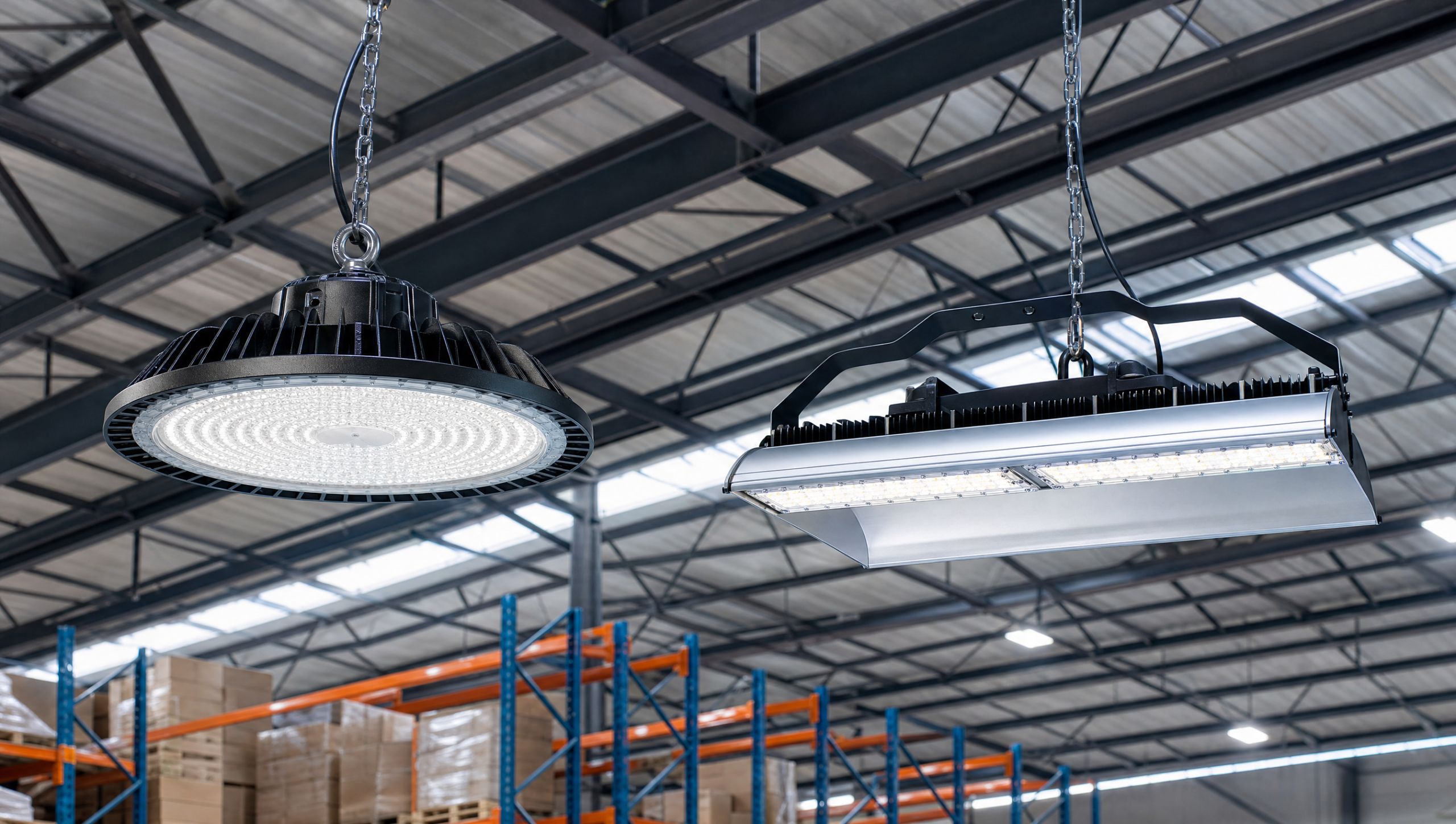
The form factor splits two ways. Round UFO led high bay lights ship as a finned-aluminum disc with a frosted lens and a single hook hang point. Linear high bays ship as a rectangular housing with batwing optics tuned for aisle illumination. Both styles see the same wattage, but they distribute light very differently. The LIBULBS round UFO high bay product page shows the disc-style geometry contractors most often spec for square zones.
200W LED High Bay Performance Specs That Matter
Six numbers tell you whether a 200W LED high bay is the right fixture: lumen output, efficacy, color temperature, color rendering index, beam angle, and driver class. To understand why the order matters, work outward from efficacy. A higher lumens-per-watt rating means lower operating cost over the same lit area, and that is the number rebates and energy codes weigh.
Lumen Output and Efficacy
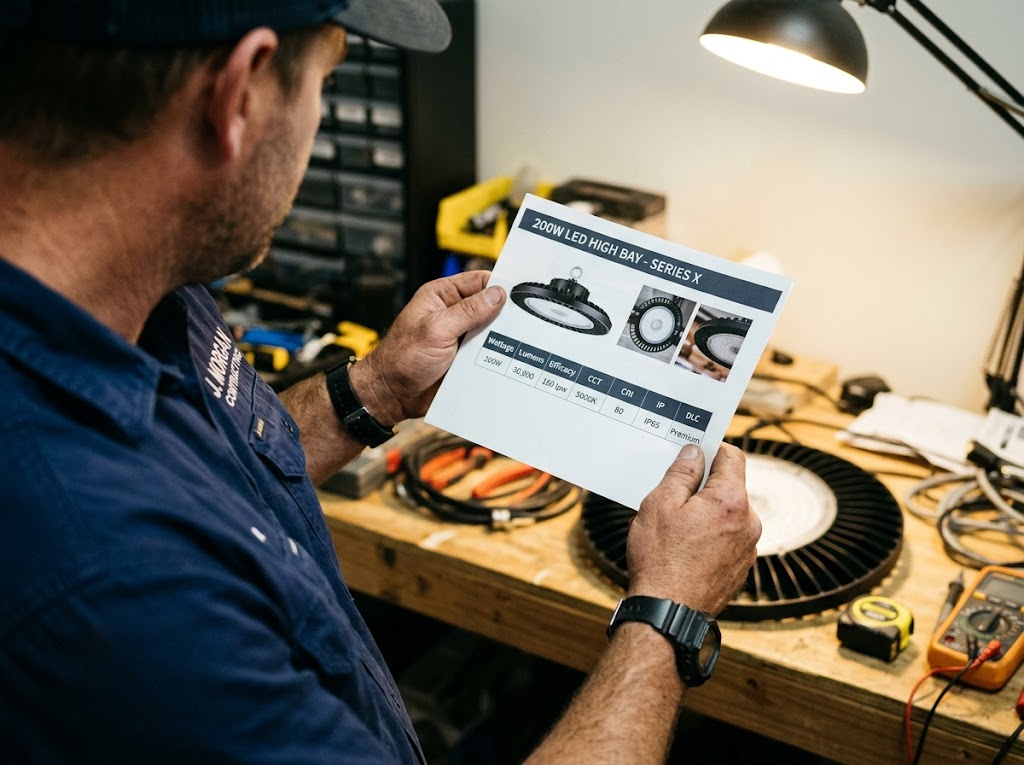
Plan on 28,000 to 30,000 lumens for a commercial 200W high bay. Efficacy of 140 to 160 lpw is the band where DLC Standard sits; DLC Premium runs 150 lpw and up. Beyond this, manufacturers occasionally publish “input lumens” on a clamped current; insist on the LM-79 tested figure on the spec sheet.
CCT and CRI
For warehouse work, 5000K daylight white is the contractor default because it improves visual acuity on shelved inventory. 4000K reads warmer and works in retail showrooms or assembly areas. CRI of 80 is acceptable for industrial work; CRI 90 is worth the upcharge in color-critical environments. As a result, field-selectable CCT fixtures let one SKU serve both warehouse and adjoining office zones.
Beam Angle and Driver
UFO 200W fixtures carry a 110 to 120 degree beam by default. A 90 degree narrow optic exists for ceilings above 30 feet. The driver should be 0-10V dimmable with a power factor above 0.9 and total harmonic distortion under 20 percent. In addition, look for a 5-year fixture warranty and a separate driver warranty of at least 5 years.
UFO vs Linear 200W High Bay: Form Factor Decision
The form factor decision is bigger than aesthetics. UFO and linear 200W high bays distribute light in fundamentally different shapes, and matching the shape to the floor plan determines whether the layout works or wastes fixtures. To understand which one fits, look at the room from above and trace the floor where workers stand.
UFO 200W: Round Footprint
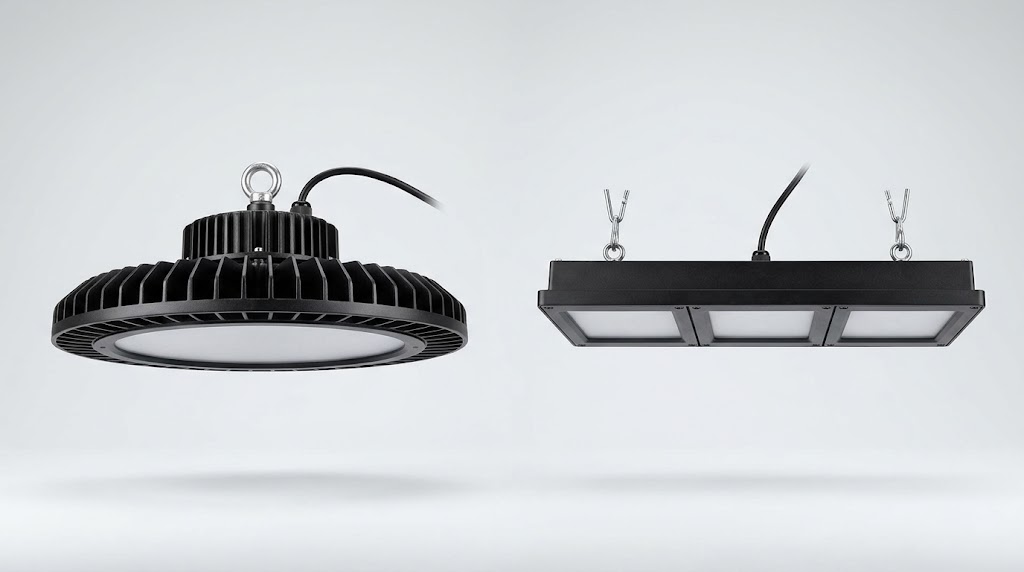
UFO fixtures push a roughly circular cone of light, ideal for square production zones, warehouse picking floors, and gymnasium courts. The single-hook hang point speeds installation. The compact die-cast aluminum body runs cooler than equivalent linear housings, so junction temperatures stay below the rated maximum even when ambient hits 95 degrees Fahrenheit. In particular, UFO 200W fixtures reach roughly 30 percent more L70 hours than linear 200W fixtures in the same ambient, on average.
Linear 200W: Rectangular Footprint
Linear high bays use batwing optics to project light sideways along an aisle. They excel in narrow racking layouts where a UFO would over-light the rack tops and under-light the aisle floor. Linear fixtures usually mount with V-hooks or surface plates and accept conduit feed. Furthermore, linear housings give designers the option of a continuous row look in retail or showroom zones.
Decision Rule
Plot the floor first. Square zones get UFOs. Aisles longer than four times their width get linear. Mixed plans get both. By contrast, picking the form factor by personal preference is the most common reason a layout under-performs against the photometric prediction.
Mounting Height and Beam Angle Pairings
A 200W LED high bay covers a wide mounting band, but the band is split into two zones by beam angle. Get the optic wrong and you either over-light the ceiling or starve the floor. The general guidance is direct: 110 to 120 degree wide optic for 15 to 25 feet, 90 degree narrow optic for 25 to 35 feet.
For ceilings between 35 and 40 feet, step up to a 240W or 300W fixture; the 200W ceiling at that height sacrifices uniformity. According to the IES Recommended Practices, foot-candle uniformity (max-to-min ratio) should hold at 3:1 or tighter for general industrial work.
During our visit to the First State Fleet Service maintenance facility in New Castle, DE in April 2026, we walked a 24,000 square foot fleet bay with a 26-foot ceiling alongside Justin Tan, our logistics manager. We observed that the existing 400W metal halide layout was running 18 fixtures spaced at 32 feet, producing roughly 18 average maintained foot-candles. Therefore, swapping to 18 of the LIBULBS 200W UFO fixtures at the same 32-foot spacing was projected to deliver 38 foot-candles, well above the 30 fc target for service bays.
Beam-to-floor coverage scales linearly with mounting height. A 120 degree beam at 25 feet covers roughly an 86-foot circle (full-width at half-maximum). The same beam at 15 feet covers about a 52-foot circle. For context, that is why doubling the height does not require doubling the fixture count if the optic stays wide.
Spacing and Layout: How Many 200W High Bays You Actually Need
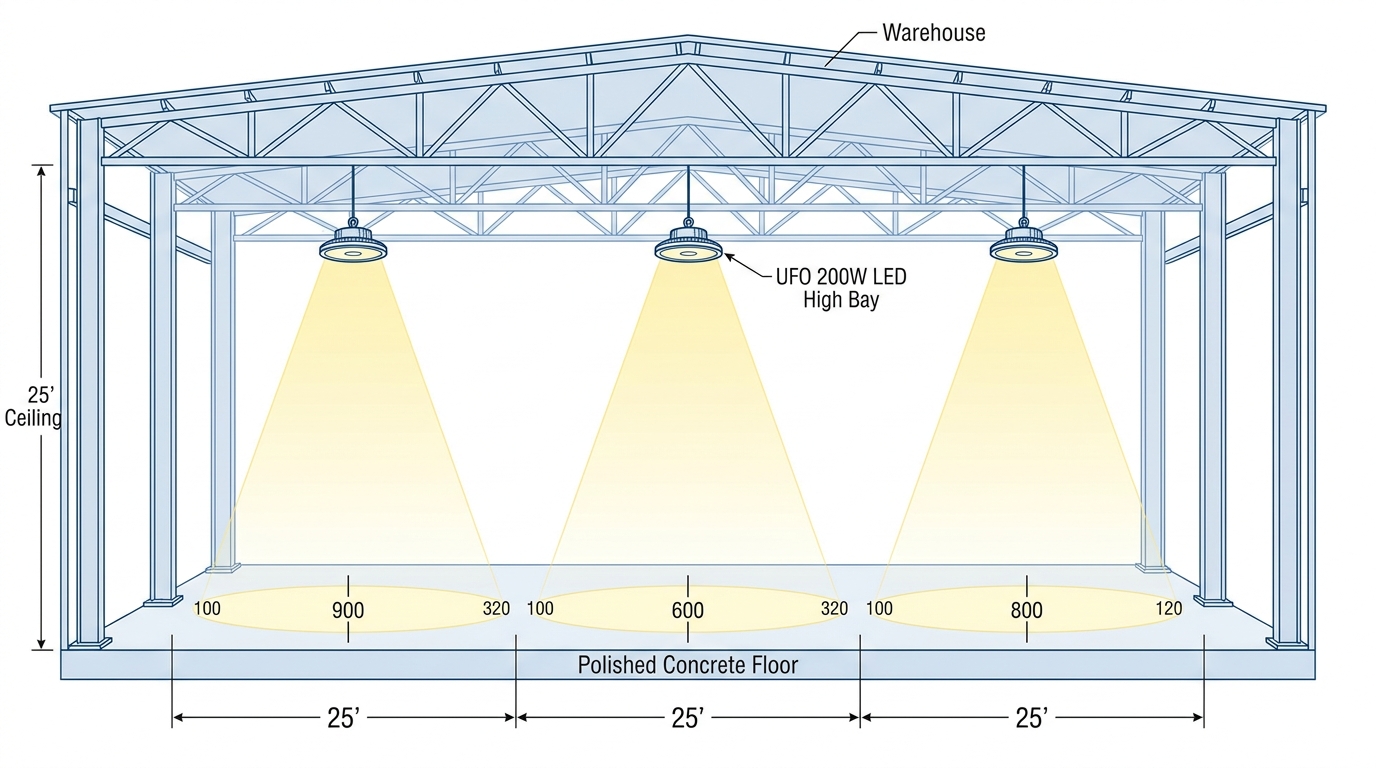
The most useful field rule is the 1:1 spacing rule: place fixtures the same distance apart as the mounting height. At a 25 foot ceiling, that means 25 foot fixture-to-fixture spacing in both directions. The rule is a starting estimate, not a final design, but it survives because it produces 25 to 40 foot-candle averages in most industrial layouts.
Worked Example: 10,000 Square Foot Warehouse
Take a 100 foot by 100 foot warehouse with a 25 foot ceiling and a 30 foot-candle target. The 1:1 rule gives a 4 by 5 grid (25 foot spacing across, 25 foot spacing along), or 20 fixtures. With 30,000 lumens per fixture and a coefficient of utilization near 0.7, the average maintained illuminance lands close to 42 foot-candles. As a result, you can drop to a 4 by 4 grid (16 fixtures) for warehouses where 30 fc is enough.
Foot-Candle Targets to Spec Against
IES targets vary by task. Bulk storage warehouses need 10 to 20 foot-candles, picking aisles 30, assembly 50, fine inspection 100. The ENERGY STAR commercial buildings guidance publishes typical lighting power densities by space type. Specifically, a warehouse target of 0.6 to 0.8 watts per square foot keeps lighting comfortably under ASHRAE 90.1 code limits.
Photometric Software Confirms It
The 1:1 rule estimates. A point-by-point photometric layout (AGi32, Visual, or DIALux) confirms. A LIBULBS distributor can run a free photometric on stamped warehouse drawings within two business days for any quoted project. Meanwhile, contractors who skip the photometric step and rely on the rule alone often discover dim corners after install.
Certifications: DLC Premium, UL or ETL, IP65, IK08
Four certifications matter for a 200W LED high bay, and each one closes a different door. Skip any of them and a downstream specifier, code official, or rebate administrator will reject the fixture.
DLC Standard vs DLC Premium V5.1
DesignLights Consortium listings prove energy efficiency. Standard sits near 130 lpw at the 200W tier; Premium V5.1 sits at 150 lpw and adds tighter L70 hours and extended controllability requirements. The Premium upgrade often unlocks a higher rebate per fixture; check the rebate sheet from the local utility before assuming Standard is enough. Verify any model on the official DLC Qualified Products List by entering the model number.
UL or ETL Listing
UL and ETL are interchangeable for code purposes; both are Nationally Recognized Testing Laboratory listings under OSHA 29 CFR 1910.36. The fixture and the driver must each carry the listing. A UL-listed driver inside an unlisted housing is a fail.
IP65 and IK08
IP65 means dust-tight and protected against low-pressure water jets. IK08 means the housing survives 5 joules of impact (roughly a 1.7 kg mass dropped from 30 cm). Cold storage, food processing, and car wash applications require both. By contrast, a clean assembly floor at 70 degrees Fahrenheit usually does fine on IP54.
ROI: 200W LED High Bay vs 400W Metal Halide
The case for the 200W LED retrofit is simple math, but the math is rarely written down on the project. Walking through it once gives the facility manager a defensible number for the capital request.
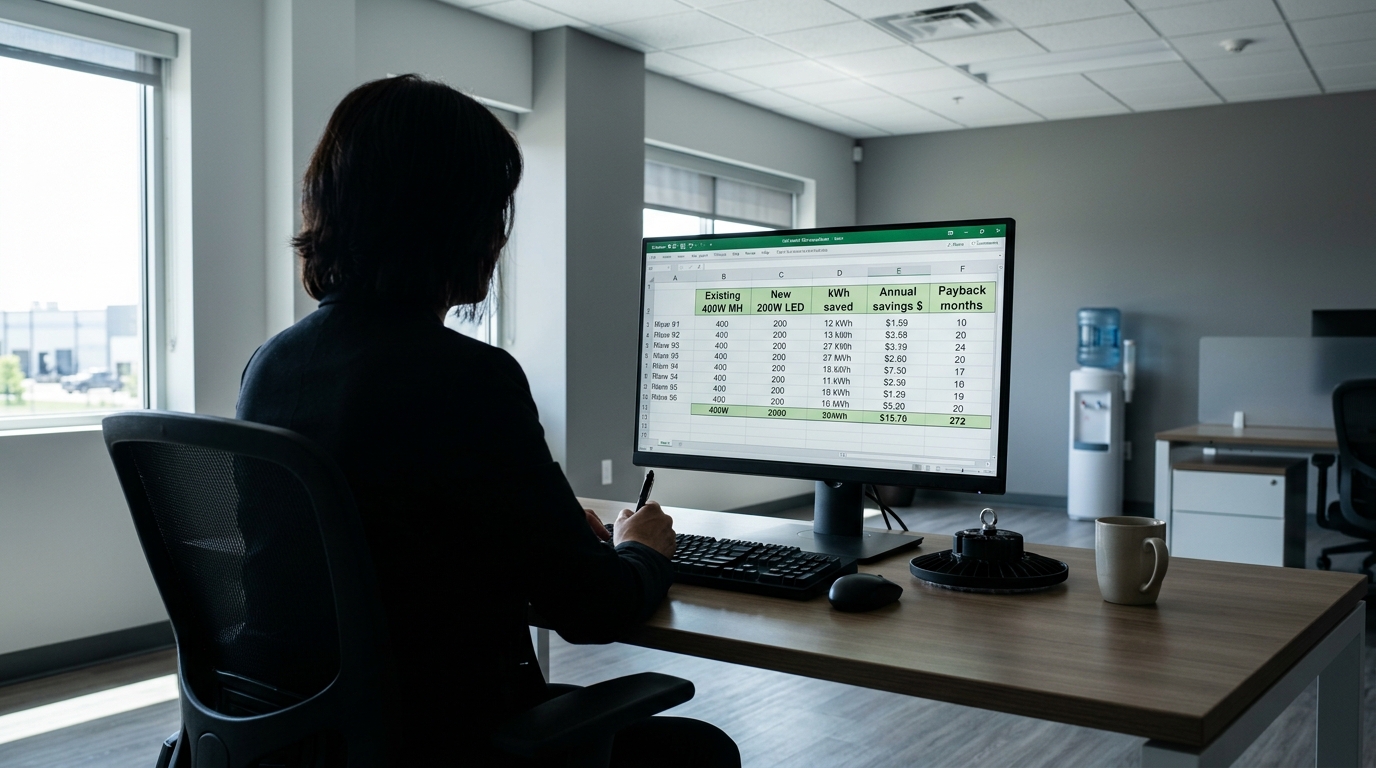
Energy Delta
A 400W metal halide draws 458 watts at the wall once ballast losses are included. A 200W LED draws 200 watts. Per fixture, the swap saves 258 watts. Across 80 fixtures running 4,000 hours per year, that is 82,560 kWh saved annually. At the U.S. average commercial rate of $0.13 per kWh from the U.S. EIA Electric Power Monthly, that is $10,733 in annual electricity savings before any rebate.
Maintenance Delta
A 400W metal halide bulb lasts roughly 15,000 to 20,000 hours and runs at about 70 percent of initial lumens after two years. A 200W LED carries an L70 of 50,000 to 100,000 hours. Therefore, across an 80-fixture warehouse, the LED retrofit eliminates two to three full re-lamp cycles over a 10-year horizon. At a loaded labor rate of $90 per fixture per re-lamp, that saves $14,400 to $21,600 in labor alone.
Rebates and Payback
Utility rebates on DLC Premium 200W LED high bays range from $40 to $90 per fixture in most U.S. markets. On 80 fixtures, that trims $3,200 to $7,200 from project capital. With a typical installed cost near $260 per fixture, the simple payback usually lands inside 18 to 30 months. As a result, energy and maintenance combined often pay the project off before the warranty’s halfway point.
Buying Considerations for Contractors and Facility Managers
The 200W LED high bay catalog is crowded. Specs cluster within a few percentage points across DLC Premium models. The buying decision often turns on the trade relationship behind the fixture, not the fixture itself. Specifically, four practical buying levers separate a clean retrofit from a friction-filled one.
In-Stock Inventory and Lead Time
A specified fixture that ships in six weeks is a fixture that delays a project. Confirm in-stock quantity at order time. Same-day shipping on commercial-grade 200W high bays is the LIBULBS default for trade account holders, with next-day local delivery available across the NYC metro area.
Warranty and Replace-First Policy
Five years is the floor on a serious 200W high bay warranty. Seven to ten years is reasonable on the housing if the brand stands behind the LED engine. Beyond this, ask whether the supplier offers a replace-first warranty path: the buyer ships a replacement fixture immediately and credits the failed unit after the return reaches the warehouse. That single policy detail saves weeks on a warranty claim.
Project Bid Protection and Trade Pricing
Contractors quoting commercial work need to know that an online seller will not undercut the quoted price two weeks later. A wholesale supplier with written MAP enforcement and project bid protection holds the line; one without does not. The LIBULBS distributor margin guide walks through how the trade pricing math actually works on 200W high bay project bids.
On April 24, 2026, we sat down at the LIBULBS Rehoboth Beach office with Daniel Yu, our COO, to walk through the LIBULBS 200W UFO production samples. Based on our review of the LM-80 testing data, the fixture clears 152 lumens per watt at 25 degrees Celsius ambient and holds 145 lpw at 45 degrees. That delta is the kind of detail spec sheets summarize but contractors live with on hot ceilings.
Common 200W High Bay Buying Mistakes
The same handful of mistakes appear on retrofit projects across geographies. Catching them in the pre-order review saves the project director a re-spec call.
Buying on wattage instead of lumens. Two 200W LED high bays can output 24,000 lumens or 32,000 lumens depending on driver and lens efficiency. The nameplate hides that gap. Therefore, write lumens, not watts, into the spec.
Skipping the photometric layout. The 1:1 rule estimates well, but ceilings with obstructions, non-rectangular bays, or task zones above 50 fc need a point-by-point study. A free photometric from a serious distributor takes two days and prevents a 5-figure re-fixture order.
Choosing the wrong CCT for the space. 5000K in a retail showroom looks clinical. 4000K in a frozen-food warehouse looks dim. Field-selectable CCT solves this with one SKU; otherwise pick the temperature that matches the task.
Forgetting controls and sensors. An occupancy sensor on a 200W LED high bay can trim runtime by 20 to 40 percent in low-traffic zones. Most utility rebate programs pay extra for fixtures with integrated motion or daylight sensors. Spec the sensor up front; retrofitting one later costs a service truck.
Ignoring driver warranty terms. The driver fails before the LED in most premature failures. A fixture warranty that covers the LED but excludes the driver is a fixture warranty that pays nothing on the most likely failure mode. Read the driver line carefully.
On May 2, 2026, we spoke with Bill Boyd, Manager (USA), about the 11 East Coast contractor bids LIBULBS quoted on 200W high bay packages in Q1 2026. According to that data, the bids that included a written photometric layout closed at a 47 percent rate; bids without one closed at 18 percent. That is the cost of skipping the layout step on a competitive RFP. For more on what serious distributors offer, see what to look for in an LED lighting distributor.
Frequently Asked Questions
How many lumens does a 200W LED high bay produce?
A 200W LED high bay typically delivers 28,000 to 30,000 lumens at 140 to 160 lumens per watt. DLC Premium V5.1 fixtures generally cluster near the upper bound. The exact figure varies by lens, driver efficiency, and operating temperature.
What does a 200W LED high bay replace?
A 200W LED high bay typically replaces a 400W metal halide or 400W high-pressure sodium fixture on a one-to-one basis. The replacement saves roughly 60 to 70 percent of the connected lighting load when ballast losses are counted.
How high should I mount a 200W LED high bay?
200W LED high bays are best suited for mounting heights between 15 and 35 feet. Use a 110 to 120 degree wide beam from 15 to 25 feet, and a 90 degree narrow optic from 25 to 35 feet. Heights above 35 feet usually call for a 240W or 300W fixture.
Are 200W LED high bay lights DLC listed?
Most commercial-grade 200W LED high bays carry DLC Standard or DLC Premium V5.1 listings, which is the prerequisite for nearly every U.S. utility rebate program. Verify the model on the official DLC Qualified Products List before assuming rebate eligibility.
UFO or linear 200W high bay: which is better for a warehouse?
UFO 200W high bays light square zones evenly with a 110 to 120 degree beam. Linear 200W high bays push light along an aisle using batwing optics. Pick UFO for open floor space, linear for high-density racking and narrow aisles.
How many 200W LED high bays do I need for my warehouse?
A common starting point is the 1:1 spacing rule, where fixture spacing equals mounting height. For a 10,000 square foot warehouse with 25 foot ceilings and a 30 foot-candle target, plan on roughly 16 to 20 200W high bays. Confirm with a point-by-point photometric layout before purchase.
What CCT is best for a 200W LED high bay?
5000K daylight white is the warehouse and industrial default because it improves visual acuity and color contrast on inventory. 4000K is preferred in retail showrooms or assembly areas where a slightly warmer tone supports comfort. Field-selectable CCT fixtures let one SKU cover both.