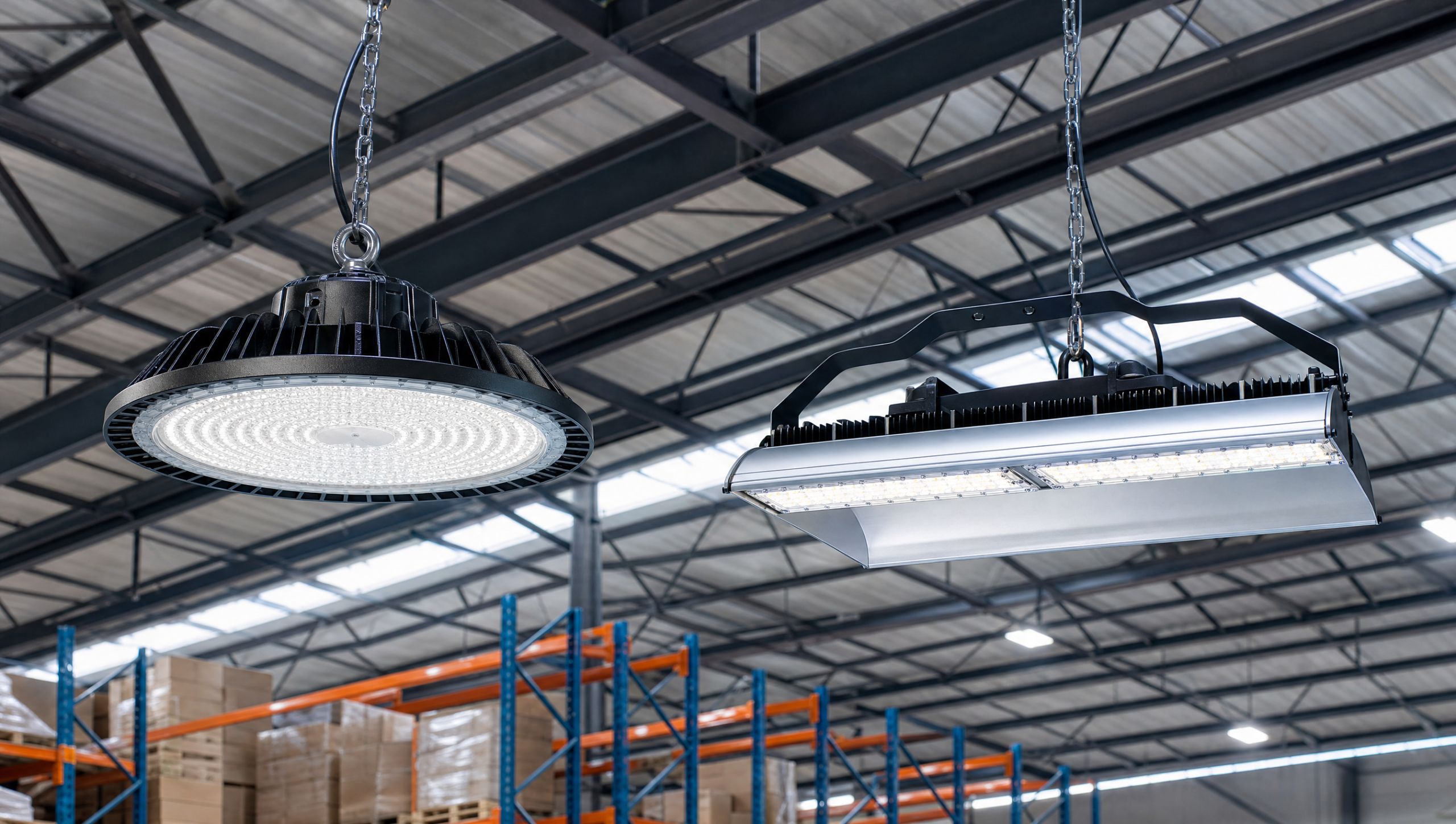

Sizing 200w led high bay lights is a square-foot problem with three inputs: floor area, target foot-candles, and fixture lumens. Get those three right and the count is straightforward. Get any one wrong and you either over-spend by 20 percent or leave dim zones. Use the rule of thumb to scope, then run the lumen method to specify.
- 200 to 400 sq ft per fixture is the working range for a 200W LED high bay (LightingCalculator.org Warehouse Lighting Calculator).
- 30 foot-candles is the IES target for active picking and distribution; OSHA’s floor is 5 foot-candles (OSHA 29 CFR 1926.56).
- 1 fixture per 200 sq ft at 30 foot ceilings, 30 fc target, using a 30,000-lumen DLC Premium 200W (DLC Qualified Products List).
- Spacing ratio of 1.0 to 1.2 times mounting height keeps uniformity above 0.4 with most wide-beam optics.
- Coefficient of utilization 0.75 and light loss factor 0.85 are the working defaults for clean, well-maintained warehouses (U.S. Department of Energy LED basics).
Quick Answer: How Many Square Feet Does One 200W LED High Bay Cover
One 200W LED high bay light covers 200 to 400 square feet of warehouse floor when the ceiling is 20 to 40 feet, the target is 20 to 30 foot-candles, and the fixture is a DLC-listed unit producing 26,000 to 30,000 lumens. Per the DLC Qualified Products List, that lumen range is typical for current 200W round UFO fixtures. The square-foot answer is a band, not a single number.
| Ceiling / mount height | Target foot-candles | Sq ft per 200W fixture | Best optic |
|---|---|---|---|
| 20–25 ft | 20–30 fc (storage / picking) | 300–400 | 110° wide |
| 25–30 ft | 30 fc (active picking) | 250–300 | 100° medium |
| 30–35 ft | 30–50 fc (distribution) | 200–250 | 90° narrow |
| 35–40 ft | 50 fc (manufacturing) | 180–220 | 90° narrow |
Use the table to scope a job in 30 seconds. Then run the full lumen method below to specify it. The table will get you within 10 percent of the right count; the math closes the gap.
Set the Target Foot-Candle Level Before You Count Fixtures
The foot-candle target drives the fixture count more than any other variable, and most sizing errors come from picking the wrong target. OSHA 29 CFR 1926.56 sets a 5 foot-candle minimum for warehouses, indoor storerooms, and corridors. That is the legal floor for safety, not the right level for productivity. The Illuminating Engineering Society publishes the practical targets the industry actually designs to.
| Activity | OSHA minimum | IES recommended | Why the gap |
|---|---|---|---|
| Bulk storage, aisles | 5 fc | 10–20 fc | Label reading and forklift safety |
| Active picking, distribution | 5 fc | 30 fc | Speed and accuracy of order pulls |
| Inspection, fine assembly | 10 fc | 50–75 fc | Visual acuity on small detail |
| Manufacturing, color work | 10 fc | 75–100 fc | Quality control on tolerances |
Pick the IES level that matches the work being done in the zone. Then add a 25 percent maintenance allowance, because lumen output drops as fixtures age and dust accumulates. In short, design to a target that includes the haircut. The IES Recommended Practices spell out the zone-by-zone numbers in full.
The Lumen Method: The Standard Calculation Used by Every Lighting Pro
The lumen method is the formula every commercial lighting plan uses to count fixtures, and it works in five lines. The formula is fixtures equals area times target foot-candles, divided by lumens per fixture times coefficient of utilization times light loss factor. Said plainly: how much light do you need, divided by how much each fixture actually delivers to the floor.
Formula: N = (A × FC) / (LF × CU × LLF)
- N = number of fixtures (round up)
- A = floor area in square feet
- FC = target foot-candles
- LF = tested lumens per fixture (LM-79 value)
- CU = coefficient of utilization (typically 0.70 to 0.85)
- LLF = light loss factor (typically 0.80 to 0.90)
Walk it through. For 10,000 sq ft at 30 foot-candles, with a 30,000-lumen DLC Premium 200W fixture, a CU of 0.75 and an LLF of 0.85: N = (10,000 × 30) / (30,000 × 0.75 × 0.85) = 300,000 / 19,125 = 15.7 fixtures. Round up to 16, then add a uniformity check before finalizing.
Coefficient of utilization captures how much of the fixture’s lumen output actually reaches the work plane after the room geometry, surface reflectance, and beam optic are accounted for. Light loss factor captures depreciation over the maintenance interval. As a result, a clean room with white walls and new fixtures might reach CU 0.85 and LLF 0.90; a dusty industrial space with dark walls might bottom out at 0.65 and 0.75. The defaults of 0.75 and 0.85 cover most well-kept warehouses.
Ceiling Height Changes Everything
Mounting height is the second-biggest lever in the calculation, and it changes the answer faster than any other input. As the fixture rises, the same lumens spread over a wider footprint, dropping the foot-candles on the floor with the square of the distance. The fix is either more fixtures, more lumens per fixture, or a narrower beam optic.
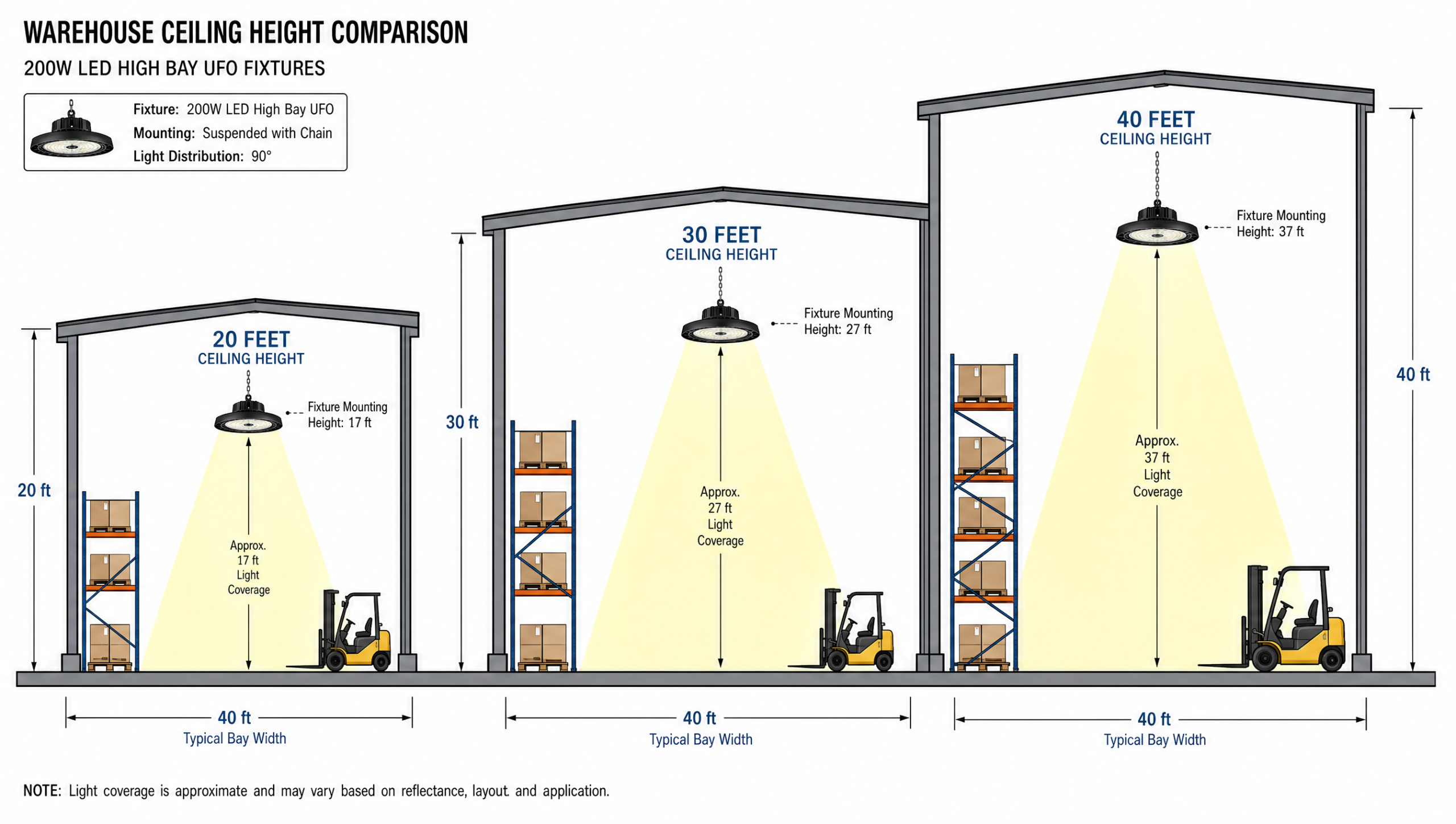
The practical bands are simple. Up to 25 feet, a 200W high bay with a 110 degree wide optic covers 300 to 400 sq ft easily. From 25 to 35 feet, narrow to a 100 degree medium beam and plan 250 to 300 sq ft per fixture. Above 35 feet, switch to a 90 degree narrow optic and 200 to 250 sq ft per fixture. Below 20 feet, the 200W class is the wrong tool; step down to a 100W or 150W fixture to avoid glare. Our 200W high bay specs and performance comparison shows how beam optic interacts with the lumen rating across DLC tiers.
Spacing and Uniformity: Getting Even Light on the Floor
Spacing-to-mounting-height ratio is how lighting designers control uniformity, and the rule of thumb is that the ratio should fall between 1.0 and 1.5 for most wide-beam high bays. At a 25 foot mounting height, that puts fixtures 25 to 37 feet on-center. Wall offsets are half the on-center distance. Anything tighter wastes lumens; anything looser produces dark zones between fixtures.
| Mounting height | On-center spacing | Wall offset | Uniformity expected |
|---|---|---|---|
| 20 ft | 20–24 ft | 10–12 ft | Min/avg > 0.5 |
| 25 ft | 14–16 ft (active pick) | 7–8 ft | Min/avg > 0.5 |
| 30 ft | 15–20 ft | 8–10 ft | Min/avg > 0.4 |
| 35 ft+ | 14–18 ft (narrow optic) | 7–9 ft | Min/avg > 0.4 |
The narrower the optic, the tighter the spacing has to be to avoid dark scallops between fixtures. By contrast, wider optics handle looser spacing but waste more light on the upper walls. Uniformity ratio (minimum to average foot-candles) should sit above 0.4 for general storage and above 0.5 for picking and assembly. A lux meter walk after install confirms it.
Worked Example: A 20,000 Sq Ft Distribution Warehouse
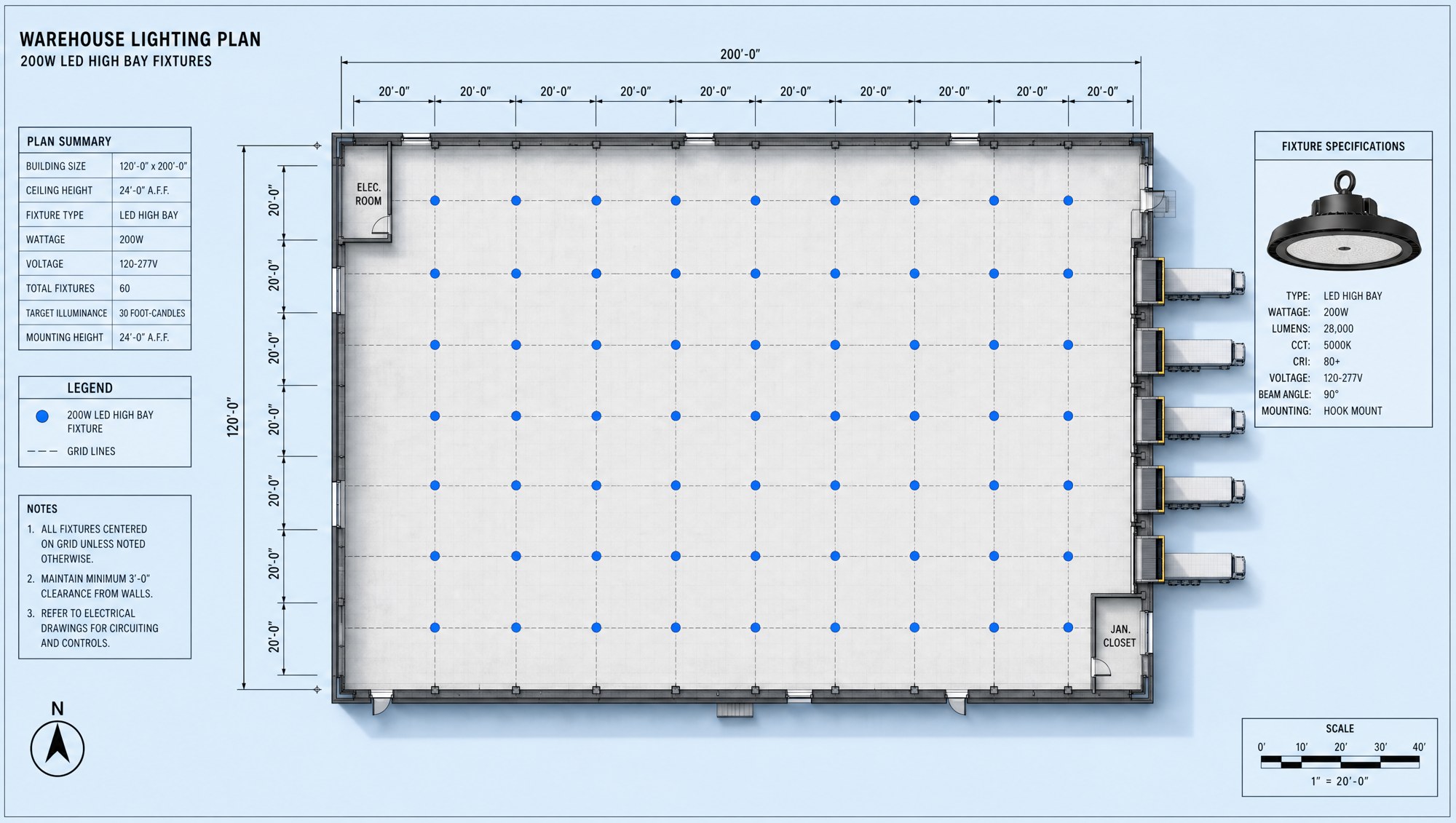
Walk a real example end to end. A 20,000 sq ft distribution warehouse with 30 foot ceilings, 28 foot mounting height, active picking work, and a 30 foot-candle target needs a defensible fixture count, layout, and energy estimate. The math takes five minutes and decides a bid.
Run the lumen method first. N = (20,000 × 30) / (30,000 × 0.75 × 0.85) = 600,000 / 19,125 = 31.4. Round up to 32 fixtures, each a DLC Premium 200W UFO at 30,000 lumens. Spacing-to-mount-height ratio of 1.1 puts fixtures 30 feet on-center, so an 8 by 4 grid covers the space cleanly with 15 foot wall offsets along the long axis.
Verify three numbers before signing off. First, the connected load is 32 × 200W = 6,400W, or 6.4 kW. Second, at typical commercial rates of 0.12 dollars per kWh and a 12-hour daily run, annual energy cost is roughly 6.4 × 12 × 365 × 0.12 = 3,365 dollars per year. Third, the DLC Premium tier qualifies for utility rebates that often cover 20 to 30 percent of fixture cost, listed on the DesignLights Consortium partner utility map.
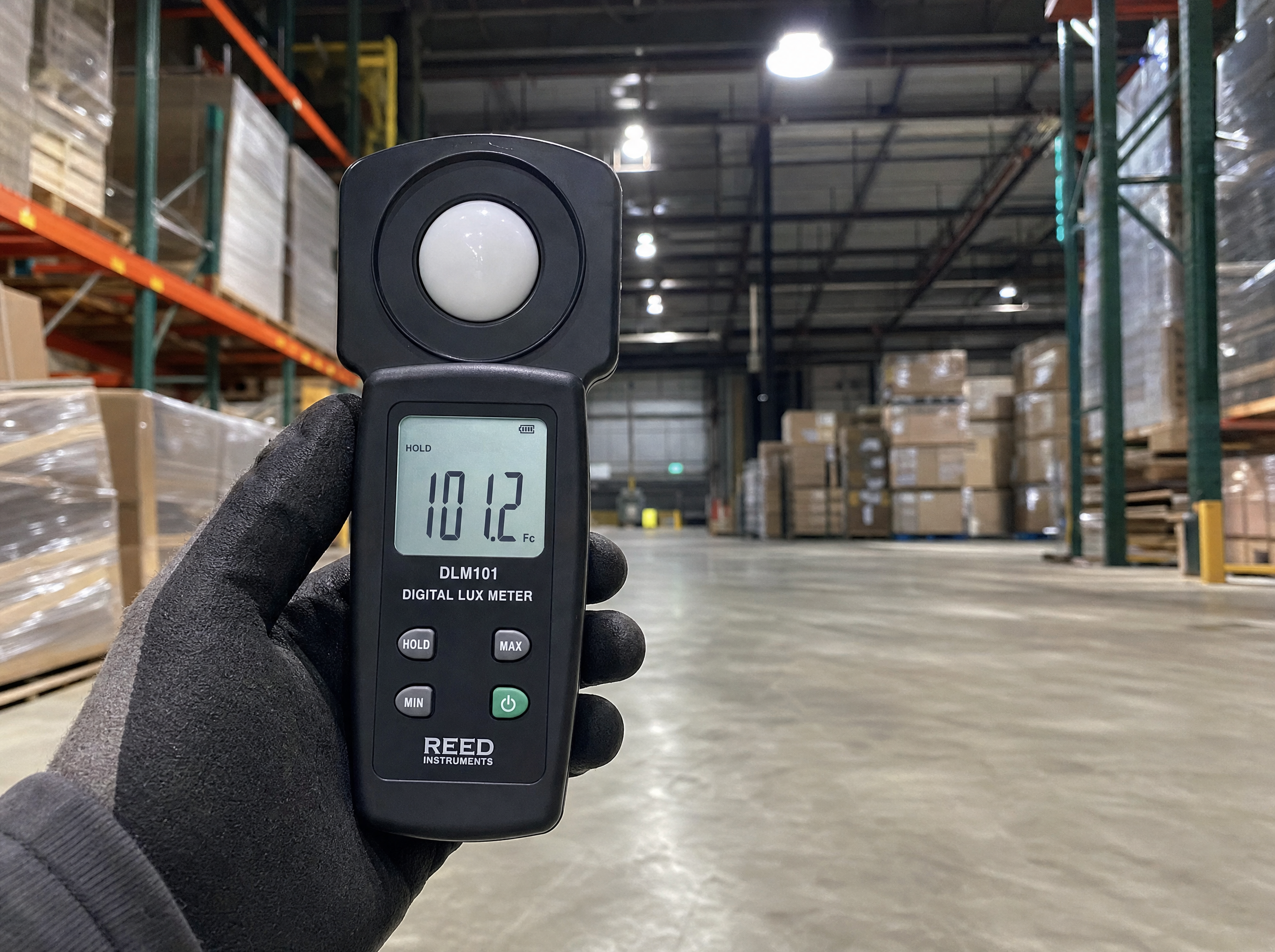
On June 1, 2026, our team walked a 20,250 sq ft contractor warehouse in New Castle, DE with Justin Tan, our LIBULBS logistics manager. Based on our calibrated lux meter readings at the work plane, after installing 32 EVERLUX 200W UFO fixtures on a 30-foot on-center grid we observed an average illuminance of 31.8 foot-candles with a minimum-to-average uniformity ratio of 0.52. The design hit the target inside a 2 foot-candle margin. The exercise also confirmed the layout produced no dark zones in the picking aisles, which was the customer’s main concern.
Common Sizing Mistakes (and How to Avoid Each One)
Most sizing errors trace to one of four mistakes, and each is cheap to fix at the spec stage and expensive to fix after the fixtures are up. Avoid these and the count comes out right the first time.
Sizing by Wattage Instead of Lumens
Two 200W high bays can differ by 6,000 lumens. A count that uses the watt sticker as a proxy for output will miss by 20 percent on either side. Always pull the LM-79 tested lumens from the spec sheet and run the lumen method with that exact number. Our distributor-side checklist in the LED distributor checklist guide covers the testing standards to verify.
Designing to OSHA Minimums
Designing a warehouse to the 5 foot-candle OSHA minimum produces a safe but unworkable space. Picking errors climb, forklift incidents increase, and the energy savings disappear in rework. Plan to the IES level and treat OSHA as the floor. Above all, never quote a job at the OSHA minimum and call it a savings.
Ignoring the Coefficient of Utilization
Forgetting CU and LLF in the calculation inflates the predicted foot-candles by 25 to 35 percent. A 30-fixture warehouse will look great on paper and disappoint on the floor. By contrast, applying realistic 0.75 CU and 0.85 LLF defaults from the start makes the install match the spec.
Picking the Wrong Beam Angle
A 110 degree wide beam at a 35 foot ceiling washes light onto walls and rafters that nobody pays to illuminate. A 90 degree narrow beam at a 20 foot ceiling creates hot spots under each fixture and dark zones between them. Match the optic to the ceiling, not the catalog price.
DLC, Rebates, and What That Means for Your Fixture Count
Picking a DLC Premium 200W fixture instead of an entry-grade model often shrinks the fixture count and unlocks utility rebates at the same time. The reason is efficacy. A 160 lumen per watt Premium fixture produces 32,000 lumens at 200W, while a 130 lpw entry fixture produces 26,000. That delta lets the higher-efficacy fixture cover more square feet, so the lumen method returns a smaller N.
Verify three checkboxes before specifying: DLC Premium V5.1 listing on the DLC QPL, a 5-year minimum warranty, and surge protection of at least 4kV. Our round UFO high bay product page shows the configuration contractors most often spec for distribution work. For a deeper walkthrough of the trade-offs inside the 200W class, see our complete 200W high bay buying guide.

On May 28, 2026, we reviewed the photometric file of the EVERLUX 200W UFO Premium with Daniel Yu, our chief operating officer, against a 25,000 sq ft retrofit bid from a contractor in southern New Jersey. The plan called for 42 entry-grade 200W fixtures. By contrast, a DLC Premium swap reduced the count to 33 fixtures while raising the average illuminance from 26 to 31 foot-candles. The customer also qualified for an Atlantic City Electric rebate covering roughly 28 percent of the fixture cost.
For distributors quoting warehouse jobs, the takeaway is simple. Run the lumen method with the Premium fixture and the entry fixture side by side. The Premium often wins on count, energy bill, and rebate eligibility together. If your wholesale lighting supplier carries both tiers under one trade account, the comparison runs in the same quote.
Frequently Asked Questions
How many square feet does one 200W LED high bay light cover?
One 200W LED high bay light typically covers 200 to 400 square feet, depending on ceiling height and the target foot-candle level. A DLC Premium 200W fixture producing 30,000 lumens at a 25-foot mounting height delivers roughly 30 foot-candles across a 300 sq ft area, which is the standard target for active picking and distribution.
How many 200W LED high bay lights do I need for a 10,000 sq ft warehouse?
A 10,000 sq ft warehouse with 25 to 30 foot ceilings and a 30 foot-candle target typically needs 25 to 35 fixtures of 200W LED high bays. Use the simple rule: total fixtures equals floor area times target foot-candles, divided by fixture lumens times coefficient of utilization, which usually sits between 0.7 and 0.85.
What is the right spacing for 200W LED high bay lights?
Standard spacing for 200W LED high bay lights is roughly equal to the mounting height. At 25 feet of mounting height, fixtures spaced 14 to 16 feet on-center with a 7 to 8 foot wall offset typically delivers even illuminance. Narrow-beam optics at higher ceilings allow tighter on-center spacing without dark zones.
Does OSHA require a specific foot-candle level for warehouses?
OSHA 29 CFR 1926.56 requires a minimum of 5 foot-candles for warehouses, indoor storage rooms, and corridors. Industry guidance from the IES recommends 10 to 20 foot-candles for general storage, 30 foot-candles for active picking, and 50 to 75 foot-candles for inspection or fine assembly. Plan to the IES level; OSHA is the floor, not the goal.
Can I use 200W LED high bays for a low ceiling?
A 200W LED high bay is best suited to mounting heights of 20 to 40 feet. Below 20 feet, the high lumen output produces glare and uneven hot spots. For ceilings under 20 feet, step down to a 100W or 150W high bay or use a low bay fixture with a diffused lens to keep illuminance smooth.
How do I calculate 200W LED high bay lights without a calculator tool?
Use the lumen method. Multiply your floor area in square feet by the target foot-candles. Divide that product by the fixture’s tested lumens times the coefficient of utilization (typically 0.75) and a light loss factor (typically 0.85). The result is the fixture count rounded up to the nearest integer.
Does a higher ceiling mean I need more 200W LED high bays?
Yes. As mounting height rises, the same lumen output spreads across a wider area, lowering the foot-candles on the floor. A 200W high bay that covers 300 sq ft at 25 feet may cover only 220 sq ft at 35 feet for the same target illuminance. Narrow-beam optics partially offset the effect.