

Here’s what every LED lighting distributor needs to know about advertised price protection and wholesale margin defense in 2026.
- LED lighting distributors with MAP enforcement average 15-30% gross margins versus 8-12% for those selling through open-market channels without pricing protection (SellerApp, 2025).
- MAP policies govern only advertised prices, not the final transaction price, making them legally distinct from resale price maintenance under U.S. antitrust law (KJK Law, 2025).
- Over 70% of brands now use AI-driven MAP monitoring tools to detect violations across online marketplaces and offline channels in real time (SellerApp, 2026).
- Territorial exclusivity and advertised price controls solve different margin problems: territory blocks regional competitors while pricing floors block online undercutting. A channel partner needs both.
- The commercial LED market reaches $93.2 billion in 2026 at 20.4% CAGR (Grand View Research, 2025), making margin protection strategies more critical than ever for wholesale partners.
Disclosure: LIBULBS is a wholesale LED lighting distributor with its own MRP (Minimum Retail Pricing) policy. This article references competitor suppliers for comparison purposes. Questions about our editorial standards can be directed to support@libulbs.com. Read our editorial policy.
What Is MAP Enforcement and Why Does It Matter for LED Lighting Distributors
MAP (Minimum Advertised Price) is the lowest price a channel partner or retailer can publicly list a manufacturer’s product. For wholesale LED suppliers, this pricing floor prevents online sellers from undercutting commercial fixture quotes. Unlike MSRP, which is merely a suggestion, a written advertised price policy carries real consequences for violators, including account suspension or termination (KJK Law, 2025).
Three pricing terms get confused constantly. MAP governs listed prices only. MSRP (Manufacturer’s Suggested Retail Price) recommends a consumer-facing selling price but has no teeth. RPM (Resale Price Maintenance) attempts to dictate the actual sale price, which raises antitrust concerns under the Sherman Act. The FTC has confirmed that unilateral advertised price policies, where manufacturers independently set and enforce minimum advertised prices, don’t violate federal antitrust law (FTC, 2024). That legal clarity is why MAP stands on firm ground.
Commercial LED fixtures are especially vulnerable to online price erosion. They’re commodity-adjacent products with specifications buyers can compare directly across suppliers. A 200W UFO high bay from one wholesaler looks identical on a spec sheet to the same fixture from another. Without advertised price protection, the only differentiator becomes cost. Online marketplaces will always win that race. The distributor who spent two hours specifying a warehouse retrofit loses the order to an Amazon listing that appeared while the contractor was reviewing the quote.
The Real Cost of Selling LED Lighting Without MAP Protection
Channel partners without advertised price protection lose between 3 and 18 margin points to online erosion, depending on the product category and the number of unauthorized sellers in the market. Industry data shows that wholesale LED suppliers with enforced pricing floors typically achieve 15-30% gross margins on commercial fixture sales, while those in open-market channels average 8-12% (SellerApp, 2025). That gap isn’t incremental. It’s the difference between a sustainable operation and a shrinking one.
Consider what happens on an actual commercial project. You quote a contractor 200 linear high bays at $85 per fixture. The contractor checks your proposal against online listings and finds the identical product listed at $68 on a marketplace. Two outcomes follow: either you match the price and eat 20% of your margin, or you lose the project entirely. Neither outcome funds your business development, warehousing, or delivery fleet.
The compounding damage extends beyond individual transactions. Once a contractor learns that your quoted price is negotiable because of online competition, every future proposal becomes a negotiation anchored to the lowest price on the internet. Your expertise in specifying the right fixture, your same-day shipping capability, and your local support all become invisible. The conversation shifts from value to cost. That’s why a written pricing policy paired with territorial exclusivity isn’t a perk of working with a wholesale partner. It’s a requirement.
How MAP Enforcement Actually Works in Practice
The manufacturer sets a minimum listed price floor, monitors all sales channels for compliance, and takes action against violators. This sounds simple. But execution is what separates effective programs from the ones that exist only on paper. A credible pricing policy follows four stages: documentation, communication, monitoring, and action (Red Points, 2025).
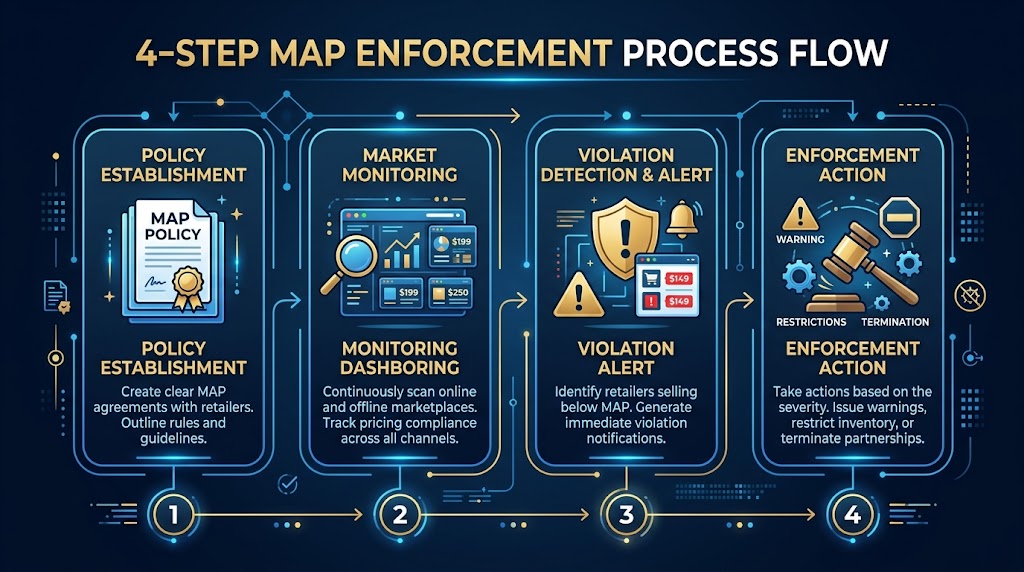
Stage 1: Policy documentation. The brand creates a written policy with specific price floors per SKU, defines what constitutes a violation, and outlines consequences. Vague policies produce vague results.
Stage 2: Communication. Every authorized partner receives the policy before signing a trade agreement. The pricing schedule is attached as an exhibit, making it contractually binding. When prices change, updated schedules ship with a defined effective date.
Stage 3: Monitoring. The brand scans online marketplaces, partner websites, and advertising channels for violations. In 2026, this is predominantly automated through AI-driven platforms that check listings across 100+ channels continuously (MetricsCart, 2026).
Stage 4: Action. When a violation surfaces, the brand investigates, warns the offending seller, and escalates to suspension or account termination for repeat offenders. The strongest programs also credit the affected partner for documented lost sales caused by the violation.
MAP vs Territorial Exclusivity: Why You Need Both
Advertised price controls stop online undercutting while territorial exclusivity stops regional competitors from selling the same product in your market. One protection without the other leaves a gap in your margin defense. A wholesale partner with pricing floors but no territory protection still competes against three other authorized sellers in the same metro area. A partner with territory but no advertised price policy watches online sellers list below wholesale cost to contractors in their exclusive zone.
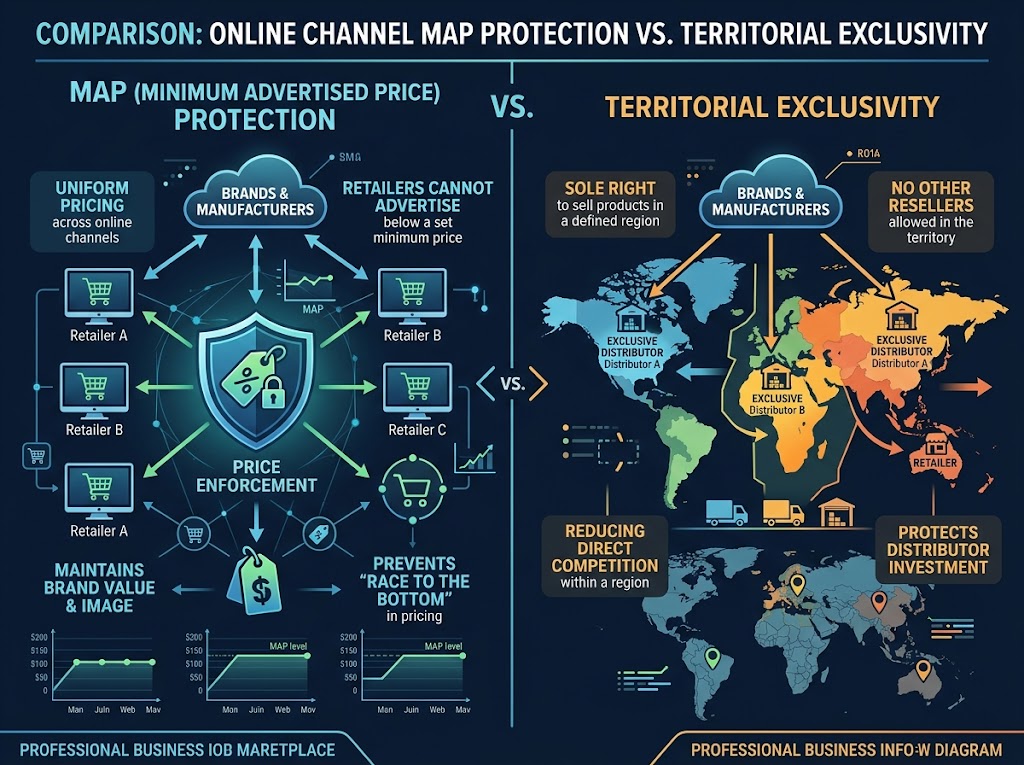
| Protection Type | What It Blocks | Where It Applies | Without It |
|---|---|---|---|
| MAP Enforcement | Online price undercutting | All advertised channels | Marketplace sellers list below your cost |
| Territorial Exclusivity | Regional competition on same brand | Defined geographic area | Neighboring distributor undercuts your quotes |
| Bid Protection | Project-level undercutting | Registered commercial projects | Competitor swoops in after you spec and quote |
Bid protection adds the third layer. When you register an active commercial project with your supplier, bid protection prevents other authorized distributors from quoting the same job. This stops the scenario where you invest hours specifying fixtures for a warehouse retrofit and a competitor contacts the same contractor with the same product at a lower price. The combination of all three protections, MAP plus territory plus bid protection, is what separates a wholesale partnership from a transactional vendor relationship. For a deeper analysis, see our guide on why territorial exclusivity matters when choosing an LED lighting distributor.
Five Signs Your LED Lighting Supplier Does Not Enforce MAP
If your supplier’s products appear on Amazon below your wholesale cost, their pricing policy isn’t being enforced, regardless of what the trade agreement says. Here are five warning signs that price protection exists only on paper.
- Their products appear on unauthorized marketplace listings. Search Amazon, eBay, and Alibaba for your supplier’s brand. If you find active listings from sellers outside the authorized network, monitoring is either absent or ignored.
- They can’t describe a prior enforcement action. Ask your rep to walk through a specific violation and what happened. If they can’t name a single instance, the policy has never been tested.
- The pricing schedule is outdated or missing from your agreement. A current schedule with per-SKU floors should be attached to your trade agreement. If it’s more than 12 months old, the policy is stale.
- Contractors consistently cite lower online prices during negotiations. When this happens on every quote, not just occasionally, the pattern reveals systemic failures across the supplier’s channel.
- Other wholesale partners in your region carry the same product line. If you have territorial exclusivity on paper but encounter competitors quoting the same brand to your accounts, the exclusivity clause isn’t being honored.
When you spot these signals, document them. Then have a direct conversation with your supplier’s leadership (not just your sales rep) about enforcement history and the resources dedicated to monitoring. If the answers aren’t satisfying, it’s time to evaluate alternatives. Our guide on what to look for in an LED lighting distributor covers the full evaluation criteria.
How AI and Automation Changed MAP Monitoring in 2026
Over 70% of brands now use AI-driven monitoring tools that scan 100+ online marketplaces for pricing violations in real time (SellerApp, 2026). Manual checks, where a brand periodically reviews a handful of websites, can’t keep pace with the velocity of price changes on platforms like Amazon, where listings update thousands of times per day.
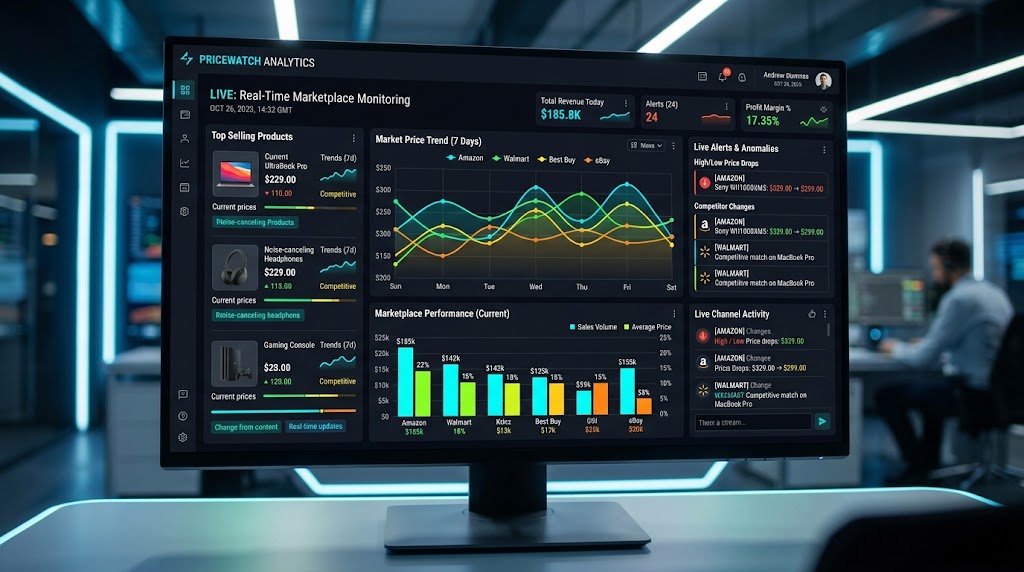
Automated platforms detect violations within minutes of a price change, capture timestamped screenshots as evidence, identify repeat offenders across multiple seller accounts, and generate resolution reports. For commercial LED brands, this technology closes the gap between having a written policy and actually backing it up. The cost of monitoring tools (typically $500-2,000 per month for mid-market brands) is a fraction of the margin erosion that unchecked violations cause across a wholesale network (MetricsCart, 2026).
In April 2026, LIBULBS Business Development Manager Kevin Vaccarino shared that switching to automated monitoring cut the company’s average violation response time from five business days to under 48 hours. “We used to rely on partners reporting violations to us,” Vaccarino explained. “Now we catch them before our partners even know they happened.” Three specifics matter when evaluating any supplier’s monitoring setup: which tool they use, how frequently it scans, and what their average response time is between detection and action. Suppliers who invest in automated monitoring signal that they take margin defense seriously. Those who rely on “we keep an eye on it” are telling you the truth about their commitment level.
What to Ask a Potential LED Lighting Supplier About MAP
Ask for a copy of the written pricing policy, the supplier’s enforcement track record, and details about their channel monitoring methodology before signing any trade agreement. These six questions separate brands with real programs from those using advertised price protection as a sales talking point.
- “Can I see the written MAP policy and per-SKU price schedule?” A credible supplier hands you the document immediately. If they need to “get back to you,” the policy may not exist in a formal, actionable form.
- “How many MAP violations did you detect and resolve last quarter?” Specific numbers demonstrate active monitoring. Zero violations either means perfect compliance (unlikely) or no monitoring.
- “What happens to a distributor who violates MAP twice?” Look for escalation: first warning, then suspension, then termination. If the answer is vague (“we have a conversation”), enforcement is weak.
- “What monitoring tools do you use to track online pricing?” Name a specific platform. “We check periodically” is not monitoring.
- “Will you credit me for a documented lost sale caused by a MAP violation?” This separates partners from vendors. A supplier who stands behind their policy financially has skin in the game.
- “Does your pricing policy cover all channels, including Amazon and third-party marketplaces?” A policy that covers only authorized websites but ignores marketplace listings isn’t protection. It’s decoration.
Strong answers to these questions indicate a brand that treats margin defense as infrastructure, not marketing. For a comprehensive evaluation framework, see our article on top questions every LED lighting distributor should answer before you sign.
How LIBULBS Enforces MAP for Its Distribution Partners
LIBULBS enforces Minimum Retail Pricing (MRP) on every product, across every channel, with consequences written into the trade account agreement. This isn’t a guideline or a suggestion. It’s a contractual obligation that applies to all 444+ SKUs in the catalog, from INFINITY panels to LIBULBS high bays to MLSN strip fixtures.
The MRP policy is one component of a three-part margin protection system:
- Minimum Retail Pricing: Per-SKU price floors enforced across all online and offline advertising channels. Violations trigger investigation, warning, and escalation to account suspension.
- Territorial Exclusivity: Each distribution partner receives a defined geographic territory. No other LIBULBS distributor operates in that zone. This eliminates same-brand regional competition entirely.
- Project Bid Protection: When a distributor registers a commercial project, that bid is protected. No other authorized partner can quote the same job with LIBULBS products.
Ready to work with a supplier that protects your pricing? LIBULBS trade accounts include MRP enforcement, territorial exclusivity, and bid protection as standard policy. Same-day shipping on in-stock items. Net 15/30 payment terms. Apply for a trade account and we’ll walk you through exactly how it works.
During a March 2026 visit to the LIBULBS distribution center in Rehoboth Beach, Delaware, COO Daniel Yu walked through the enforcement workflow: violation detection triggers an internal review within 24 hours, a formal notice goes to the offending account within 48 hours, and repeat violators face suspension within 7 business days. “The policy works because it isn’t discretionary,” Yu noted. “The response is the same regardless of account size.” For more on the complete wholesale program, see our guide on how to become an LED lighting distributor in 2026.
MAP Enforcement and the Commercial LED Market Outlook
The commercial LED market reaches $93.2 billion in 2026, growing at a 20.4% CAGR (Grand View Research, 2025). Distributors who protect margins now position themselves to capture meaningful share of that expansion. Those who compete on price alone will find their margins compressed further as the market scales and more sellers enter.
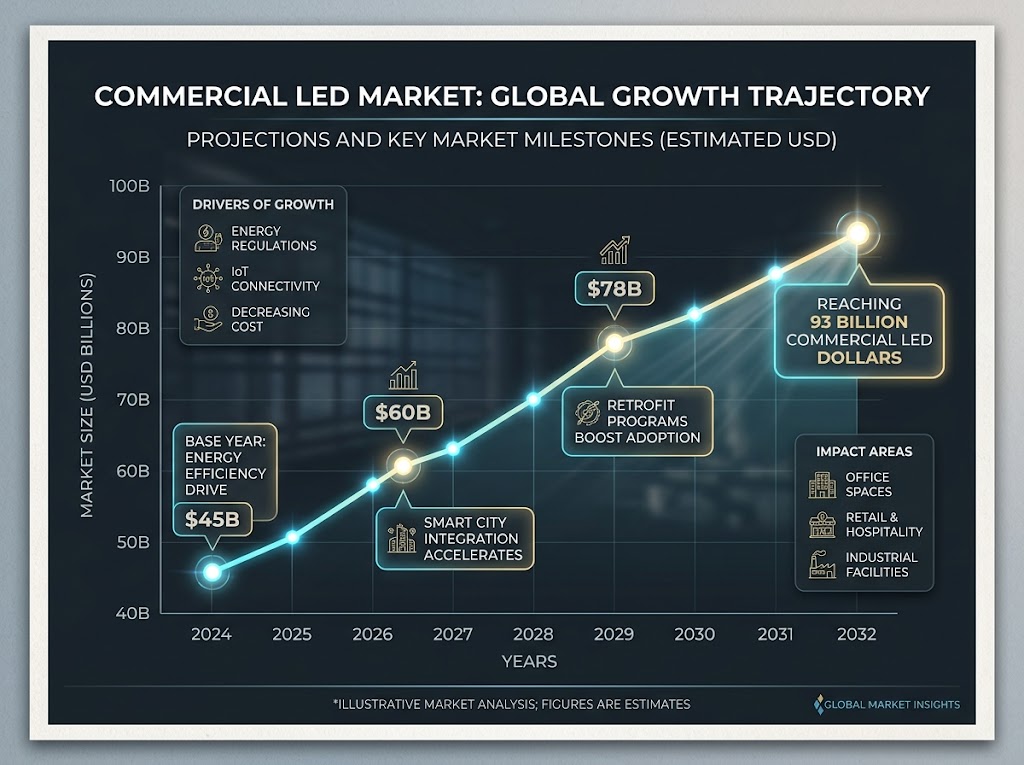
Market growth creates two simultaneous effects. More projects mean more revenue opportunity for wholesale partners. But more projects also attract more sellers, more online competition, and more pressure on pricing. Without advertised price controls, growth becomes a trap: higher revenue but lower margins, more volume but less profit per fixture. The channel partners who thrive in a $93 billion market are those who locked in pricing protection before the competition intensified.
For LED lighting distributors evaluating their 2026 strategy, the math is straightforward. A 15% margin on growing volume compounds into a sustainable business. An 8% margin on the same volume leaves nothing for reinvestment, local inventory, or the delivery capability that wins contractor loyalty. Advertised price protection isn’t a policy preference. It’s financial infrastructure. For detailed margin analysis, read our article on LED lighting distributor profit margins in 2026.
Protect your margins before the market gets more competitive. LIBULBS offers MAP enforcement, territorial exclusivity, and same-day shipping as part of every trade account. Apply for a trade account to see how these policies protect your business.
Frequently Asked Questions About MAP Enforcement for LED Distributors
What is MAP pricing enforcement for LED lighting?
MAP (Minimum Advertised Price) enforcement for LED lighting is when a manufacturer sets the lowest price that distributors and retailers can publicly advertise their products. It governs only advertised prices, not the final negotiated transaction price. For LED lighting distributors, MAP enforcement prevents online retailers from advertising fixtures below the wholesale cost structure, protecting distributor margins on commercial projects.
Is MAP enforcement legal in the United States?
Yes, MAP enforcement is legal in the United States. The FTC has confirmed that unilateral advertised price policies don’t violate federal antitrust law (FTC, 2024). MAP policies govern advertised prices only, making them legally distinct from resale price maintenance (RPM), which can violate antitrust law. The key distinction is that MAP doesn’t control the actual sale price, only the publicly advertised price. Manufacturers can independently choose to stop doing business with distributors who violate their MAP policy without coordinating pricing agreements.
How do distributors report MAP violations?
Distributors report MAP violations by documenting the violation with screenshots showing the advertised price, the product listing URL, and the date. Most manufacturers with active MAP programs provide a dedicated reporting channel, whether through email, a portal, or a direct rep contact. Effective manufacturers investigate within 48 hours, issue a formal warning to the violator, and follow up with the reporting distributor on the resolution.
What is the difference between MAP and MSRP?
MAP (Minimum Advertised Price) is the lowest price a retailer or distributor can publicly advertise. MSRP (Manufacturer’s Suggested Retail Price) is the recommended selling price to end consumers. MAP is enforceable through trade agreements, while MSRP is advisory only. For LED lighting distributors, MAP is the more impactful policy because it directly protects the pricing floor visible to contractors and end buyers shopping for commercial fixtures.