
The commercial LED market hits $93.2 billion this year. Most new distributors still fail within two years because they pick the wrong supplier, ignore pricing protection, or underestimate cash flow. Here’s how to avoid those mistakes and build a profitable wholesale lighting business.
- The global commercial LED lighting market is projected to reach $93.2 billion in 2026, growing at a 20.4% CAGR (Grand View Research, 2025).
- LED distributors with MAP enforcement and territorial exclusivity protect 15-30% gross margins, compared to open-market sellers averaging 8-12%.
- You need a business license, resale certificate, and $10,000-$50,000 in starting capital depending on your inventory model.
- Modern commercial LEDs now achieve 130-200+ lumens per watt, nearly doubling efficiency from five years ago (U.S. Department of Energy, 2025).
- Distributors who offer same-day shipping and technical support win repeat business from contractors working against tight project deadlines.
Disclosure: LIBULBS is a wholesale LED lighting manufacturer and distributor based in Rehoboth Beach, Delaware. This guide references our distributor program alongside general industry guidance. Competitors mentioned include Beyond LED Technology and Brilled Lighting. Read our editorial policy. For inquiries, contact service@libulbs.com.
What Does an LED Lighting Distributor Actually Do
An LED lighting distributor purchases commercial and industrial LED fixtures in bulk from manufacturers, then resells them to contractors, electrical wholesalers, property managers, and facility operators. The distributor sits between the factory and the job site, handling order fulfillment, technical product selection, and post-sale warranty support.
This role is distinct from a manufacturer’s representative, who earns commissions without carrying inventory. It’s also different from a storefront showroom selling individual fixtures to homeowners. As a B2B wholesale partner, your customers order 50 to 5,000 units per project, and they expect trade pricing, payment terms, and product expertise.
The best distributors don’t just move boxes. They help contractors pick the right fixture for a specific ceiling height, ambient temperature, or lighting code requirement. That technical knowledge builds the kind of trust that turns one-time orders into long-term accounts.
Why 2026 Is the Right Year to Start an LED Distribution Business
The commercial LED lighting market reached $77.4 billion in 2025 and is on track to surpass $93.2 billion in 2026 (Grand View Research). That 20.4% compound annual growth rate is driven by three forces that show no signs of slowing down.
First, energy code compliance. Updated building codes in 40+ U.S. states now mandate LED-equivalent efficiency levels for commercial renovations and new construction. Facilities that still run fluorescent or HID fixtures face compliance deadlines that push them toward LED retrofits.
Second, commercial construction activity. Warehouse and logistics facility construction continues to expand, with industrial real estate development hitting record square footage in 2025 according to NEMA industry reports. Each new facility needs hundreds of high bay fixtures, panels, and exterior lighting.
Third, technology maturation. Modern commercial LEDs deliver 130-200+ lumens per watt, nearly double the efficiency from 2020. Connected lighting systems with occupancy sensing, daylight harvesting, and building automation integration are becoming standard on new commercial projects. Distributors who understand these technologies win larger project scopes.
LIBULBS has tracked this trajectory firsthand. Our advisory board member John Brennan developed the first LED T8 tube with an internal driver, and we’ve watched each generation of commercial LED technology expand the addressable market for distributors. When we onboarded a new partner in the Delaware-Maryland corridor in January 2026, their first 90 days confirmed what the data shows: commercial contractors can’t find enough qualified wholesale sources to meet project timelines.
LED Lighting Distribution Business Models Explained
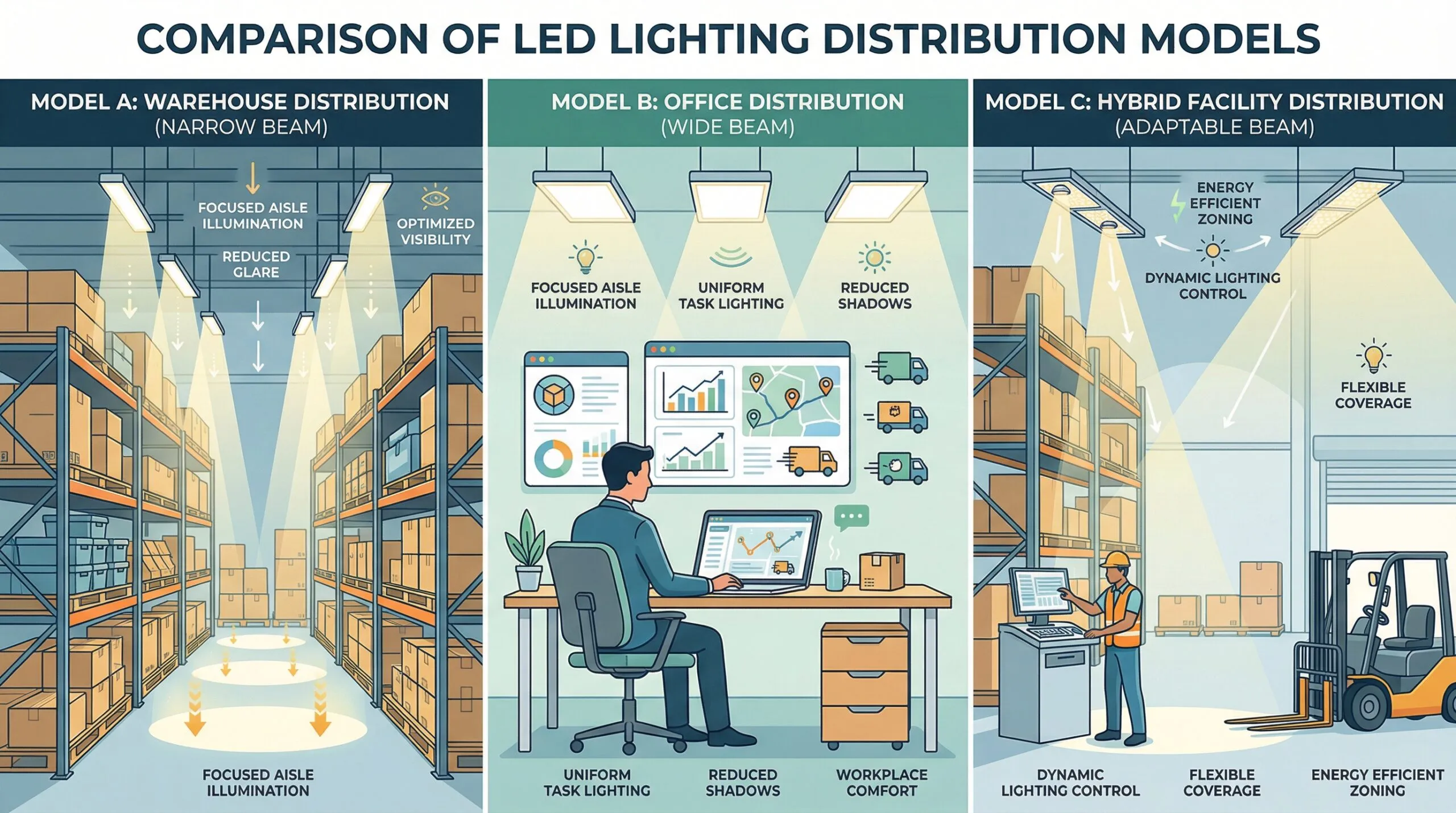
Choosing the right model determines your startup capital, your cash flow cycle, and your ability to fulfill orders quickly. Three proven approaches dominate the commercial wholesale space, and each has clear trade-offs.
Stocking Distributor
You purchase inventory upfront and warehouse it in your own facility. This model requires $25,000-$50,000 in initial inventory investment, plus warehouse lease costs. The advantage is speed: you ship from your own stock, often same-day. Contractors on tight deadlines will pay a premium for that reliability. The risk? Tying up capital in product that sits on shelves if you misjudge demand.
Drop-Ship Model
Your supplier ships directly to your customer under your branding (blind shipping). Startup costs drop to $10,000-$15,000 for licensing, a website, and initial marketing. You carry zero inventory risk. The trade-off is longer delivery times and less control over packaging and fulfillment quality. Not every supplier offers blind shipping, so confirm this before you commit.
Hybrid Model
Stock your top-selling SKUs (panels, troffers, high bays) and drop-ship specialty items (emergency battery backup units, custom CCT fixtures, niche form factors). This approach balances speed with capital efficiency. Most established LED lighting distributors eventually migrate to a hybrid model as they learn which products move fastest in their territory.
| Model | Startup Capital | Delivery Speed | Inventory Risk | Best For |
|---|---|---|---|---|
| Stocking | $25,000-$50,000 | Same-day | High | Metro areas with contractor demand |
| Drop-Ship | $10,000-$15,000 | 2-5 business days | None | New distributors testing the market |
| Hybrid | $15,000-$30,000 | Same-day (core), 2-5 days (specialty) | Moderate | Growing distributors with established accounts |
Licenses and Legal Requirements for LED Lighting Distributors
Every wholesale operation needs a legal foundation before placing its first order. Requirements vary by state, but four elements apply almost universally across the United States.
Business entity registration. Form an LLC or corporation through your state’s Secretary of State office. An LLC provides personal liability protection while keeping tax filing straightforward. The U.S. Small Business Administration provides state-by-state registration guides.
Resale certificate. Also called a sales tax exemption certificate, this document lets you purchase inventory without paying sales tax at wholesale. You collect sales tax from your customers instead. Apply through your state’s Department of Revenue. Processing typically takes 5-15 business days.
Contractor licensing. If you plan to install fixtures in addition to selling them, most states require an electrical contractor license. Pure distribution (selling without installation) generally doesn’t require contractor licensing, but verify your state’s specific rules.
Business insurance. General liability insurance ($1 million minimum) protects against product liability claims. If you warehouse inventory, add commercial property coverage. Expect $1,200-$3,000 annually for a small distribution operation.
Most wholesale LED lighting suppliers will ask for your resale certificate and business license before opening a trade account. Having these documents ready before you approach suppliers accelerates the onboarding process.
How to Choose the Right LED Lighting Supplier
Your supplier determines your product quality, your margin stability, and your ability to fulfill orders on time. Choosing poorly means lost bids, warranty headaches, and customers who leave after one project. Here are the four areas that separate a reliable wholesale LED lighting supplier from a liability.
Product Quality and Certifications
DLC (DesignLights Consortium) certification is non-negotiable for commercial LED products. DLC-listed fixtures qualify end customers for utility rebates that offset 30-50% of the purchase cost. Without DLC certification, your fixtures are at a pricing disadvantage on every commercial bid. Also verify UL listing (safety compliance) and IP ratings for specialized environments. IP65-rated fixtures are required for car washes, food processing plants, and cold storage facilities.
MAP Enforcement and Pricing Protection
How many bids have you lost because your quoted price showed up on Amazon for 20% less? That’s what happens without MAP enforcement. Online sellers undercut your project quotes with the same product at razor-thin margins. You either match and destroy your margin, or lose the project entirely. Minimum Advertised Price enforcement is the single most important factor in long-term margin stability.
Ask every prospective supplier: do you enforce MAP? Is it in the trade account agreement? What happens when a violation occurs? A verbal commitment is worthless. Written MAP enforcement with clear consequences is the standard you should require.
Territorial Exclusivity and Bid Protection
Territorial exclusivity guarantees no other distributor sells the same product line in your geographic area. Bid protection prevents a supplier from undercutting your active project quotes through another channel. These two policies together give you the confidence to invest in relationship-building with contractors and facility managers in your territory, knowing your investment is protected.
Not all suppliers offer territorial exclusivity. Many prefer an open model that maximizes their own volume at the expense of partner margins. If you hear “we don’t limit where our partners sell,” recognize that your territory isn’t protected.

Shipping Speed and Inventory Reliability
Contractors work against project deadlines. A six-week lead time from an overseas supplier loses jobs to the partner who ships same-day from domestic stock. During a February 2026 walkthrough of the LIBULBS warehouse in Rehoboth Beach, Delaware, logistics manager Justin Tan showed us the fulfillment line processing a 150-unit LIBULBS high bay order. It shipped the same afternoon. That’s the kind of turnaround contractors expect.
Verify your supplier’s in-stock rates, shipping cutoff times, and local delivery capabilities. Same-day shipping on in-stock items and next-day delivery in metro areas aren’t nice-to-haves anymore. They’re the baseline.
If you’re evaluating wholesale partners with these protections, LIBULBS trade accounts include written MAP enforcement, territorial exclusivity, and same-day shipping.
Understanding LED Lighting Distributor Profit Margins
Distributors with supplier-enforced pricing protection typically achieve 15-30% gross margins on commercial fixture sales. Those selling through open-market channels without MAP enforcement average 8-12%, and that number compresses further as online competition grows. Kevin Vaccarino, LIBULBS business development manager for the USA, shared a telling comparison in March 2026: two partners selling identical LIBULBS high bays in adjacent states. The one with territorial exclusivity maintained a 24% gross margin. The one in an overlapping territory averaged 11%.
The margin difference comes down to pricing discipline. When your supplier enforces MAP across every sales channel, your quoted price stays competitive without a race to the bottom. Your customer can’t find the same fixture for less by searching online, which removes the single biggest objection in B2B sales.

Payment terms affect cash flow as much as margins. Look for suppliers offering Net 15 or Net 30 terms (subject to credit approval). These terms let you invoice your customer, collect payment, and then settle with your supplier rather than paying upfront for every order. For project-based work where contractors pay on 30-45 day cycles, your own supplier terms need to accommodate that reality.
Additional revenue streams beyond fixture markup include volume rebates from manufacturers (typically 1-2% on annual purchases exceeding agreed minimums), co-op marketing funds for local advertising, and extended warranty upsells on high-value installations like pole lighting and high bay systems.
Building Your LED Lighting Product Catalog
A focused product catalog outperforms a bloated one, especially in your first year. Start with the six commercial LED fixture categories that account for the majority of contractor and facility manager purchases.
LED panels and troffers dominate office, healthcare, and education projects. These fixtures replace fluorescent grid-ceiling lights and represent the highest-volume product category for commercial distributors. Field-selectable CCT and wattage options reduce the number of SKUs you need to stock.
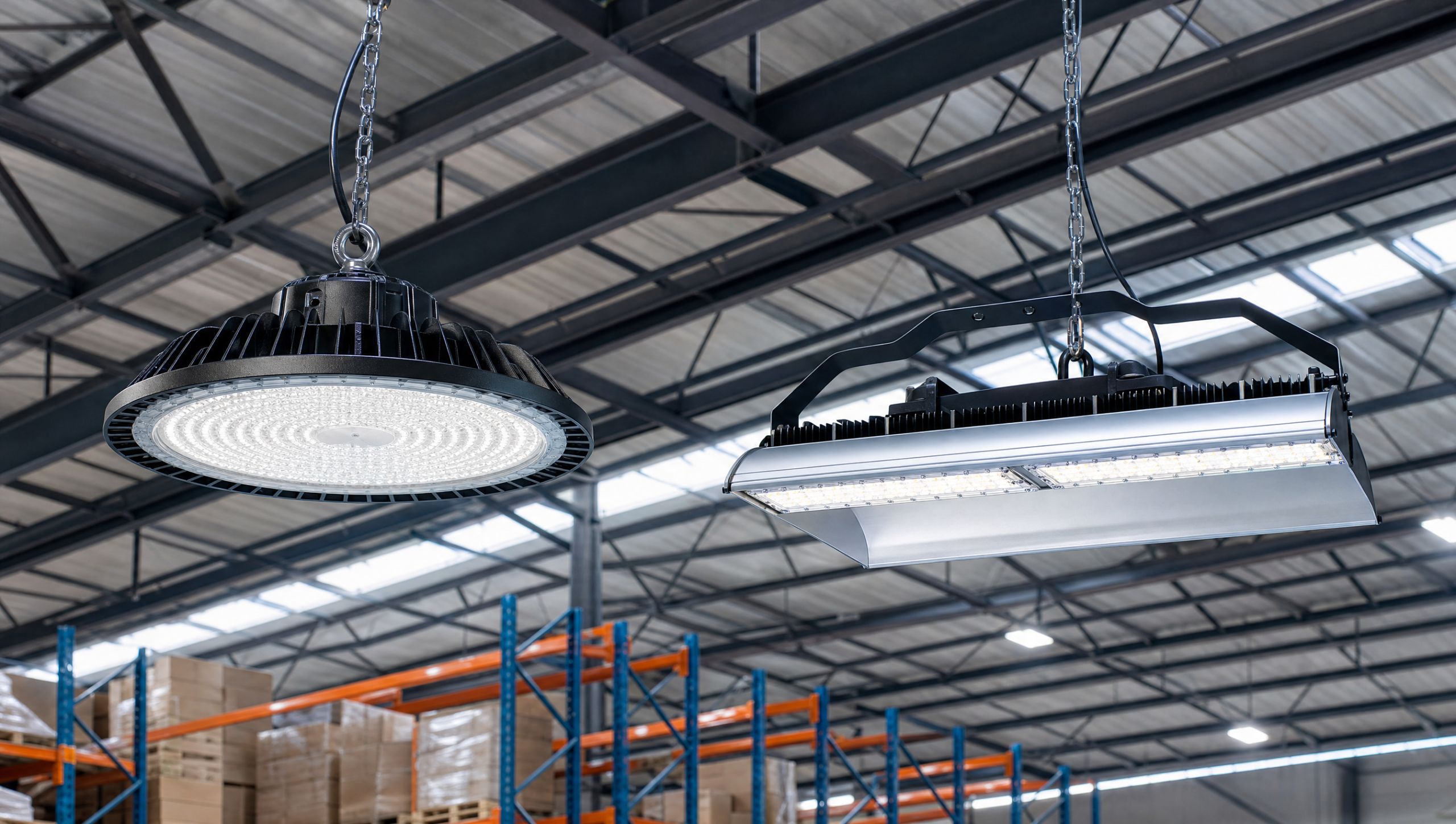
LED high bays (round UFO and linear styles) serve warehouses, logistics centers, manufacturing plants, and commercial storefronts with ceilings above 15 feet. High bays are high-ticket items with strong margin potential. Products like the LIBULBS round high bay series deliver up to 160 lumens per watt with DLC certification.
Vapor tight fixtures with IP65 ratings handle wet, dusty, and corrosive environments: parking garages, car washes, food processing, and cold storage. This is a specialty category where product knowledge becomes a sales advantage.
Wall packs, flood lights, and pole lights cover exterior and parking lot applications. These products carry longer warranties (5-7 years on quality fixtures) and generate repeat orders from property management companies.
Resist the temptation to carry every SKU a supplier offers. Focus on 50-100 core SKUs that cover your local market’s most common project types, then expand based on actual customer requests.
Marketing Your LED Lighting Distribution Business
When was the last time a commercial contractor picked a supplier from a banner ad? It doesn’t happen. Successful distributors build their customer base through direct relationships with contractors and facility managers, not through mass advertising. The commercial buyer researches online, evaluates at trade shows, and buys from the partner who demonstrates product knowledge and reliable fulfillment.
Build a professional website with your product catalog. Contractors and purchasing managers will search for “LED lighting distributor” plus their city or region. A clean site with product specifications, certifications, and a trade account application form captures that search intent.
Create and verify a Google Business Profile. For B2B companies, a GBP listing is a trust signal that validates your physical presence. Include your business hours, service area, and product categories. Encourage early customers to leave reviews.
Attend regional electrical and construction trade shows. Events hosted by NEMA, local electrical associations, and building owner groups put you in front of qualified buyers. Bring product samples and spec sheets, not brochures.
Publish project spotlights and case studies. When you complete a noteworthy installation, document the project with photos, product specs, and results. A case study showing how you helped a contractor deliver 200 high bays on a 48-hour turnaround is more persuasive than any product data sheet.
LinkedIn is the strongest social platform for reaching electrical distributors and commercial contractors. Share project results, technical insights, and industry news. One post per week, focused on a single useful idea, builds credibility faster than daily promotional noise.
Common Mistakes New LED Lighting Distributors Make
Most LED distribution startups that struggle in their first two years make the same five errors. Recognizing these mistakes before you launch saves capital, reputation, and time.
Choosing a supplier without MAP enforcement. This is the costliest mistake. Without it, your pricing gets undercut online within months. Every project you quote becomes a negotiation against Amazon and eBay sellers running the same product at 10-15% above their own cost.
Carrying too many SKUs too early. A 500-SKU catalog sounds impressive until you have $30,000 in slow-moving inventory. Start with 50-100 products that match your territory’s most common project types. Expand based on actual demand, not supplier catalogs.
Ignoring payment terms and cash flow. Commercial projects operate on 30-60 day payment cycles. If your supplier demands payment upfront while your customer pays Net 45, you carry the cash gap. Negotiate Net 15 or Net 30 terms with your supplier before committing to large orders.
Skipping certification checks. Selling non-DLC fixtures means your customers can’t access utility rebates. Selling non-UL-listed products creates liability exposure. Always verify independently through the DLC Qualified Products List.
Neglecting post-sale support. The warranty claim process is where loyalty is built or destroyed. Confirm your supplier’s warranty process, turnaround time, and whether they issue credits, replacements, or both. A 5-year warranty that takes 90 days to process a claim isn’t a real warranty.
Want to see what a distributor-first supplier relationship looks like? LIBULBS trade accounts come with MAP enforcement, territorial exclusivity, bid protection, and Net 15/30 terms.
Step-by-Step Checklist to Launch Your LED Distribution Business
Use this checklist as your launch sequence. Each step builds on the previous one.
- Register your business entity (LLC or Corporation) through your state’s Secretary of State.
- Obtain a resale certificate from your state’s Department of Revenue.
- Secure business insurance ($1M general liability minimum).
- Research your local market to identify the most common commercial project types (office, warehouse, storefront, exterior).
- Evaluate 3-5 wholesale LED suppliers on certifications, MAP enforcement, territorial exclusivity, shipping speed, and payment terms.
- Open a trade account with your selected supplier and place a trial order.
- Build a professional website with your product catalog, certifications, and trade account application.
- Create and verify your Google Business Profile.
- Contact 20 local contractors and facility managers with a product sample and your spec sheets.
- Fulfill your first project order and document it as a case study for your marketing.
Frequently Asked Questions About LED Lighting Distribution
How much money do you need to start an LED lighting distribution business?
Between $10,000 and $50,000 depending on your model. Drop-ship requires $10,000-$15,000 (licensing, website, marketing). Stocking requires $25,000-$50,000 (add inventory and warehouse). The hybrid approach falls between at $15,000-$30,000.
Do you need a license to sell LED lighting wholesale?
Yes. You’ll need a business license and a resale certificate from your state. Some states require additional contractor licensing if you also install fixtures. The SBA provides state-by-state guides.
What is MAP enforcement and why does it matter for LED distributors?
MAP (Minimum Advertised Price) enforcement prevents any reseller from advertising a product below a set price floor. It protects your margins by stopping online sellers from undercutting your project quotes. Without it, you’ll routinely lose bids to e-commerce sellers offering identical products at razor-thin margins.
How do LED lighting distributors make money?
Through the markup between wholesale cost and resale price. Protected partners with MAP enforcement and territory exclusivity typically achieve 15-30% gross margins. Additional income includes volume rebates (1-2% annually), co-op marketing funds, and extended warranty upsells.
What certifications should LED lighting products have?
DLC certification for utility rebate eligibility, UL listing for safety compliance, and IP ratings for environmental protection. DLC is critical because it qualifies end customers for rebates covering 30-50% of fixture cost.
Can you start an LED distribution business from home?
Yes. Many successful partners start from a home office using supplier drop-shipping. You’ll need a business license, resale certificate, and reliable internet. Once you’re past $15,000-$20,000 monthly volume, consider moving to a warehouse for faster local fulfillment.
What is territorial exclusivity in LED lighting distribution?
A supplier guarantee that no other partner sells their products in your geographic area. This prevents price competition on the same product line and gives you confidence when quoting projects. Not all suppliers offer it. Before signing, ask specifically about territory protection. Contact LIBULBS to discuss available territories.