

Here is what electrical contractors need to know about LED lighting distributor programs before signing a trade agreement in 2026.
- MAP enforcement protects margins by up to 24% compared to 11% in overlapping open-market territories (LIBULBS margin analysis, 2026).
- Territorial exclusivity is legal and procompetitive under FTC rule-of-reason guidelines when competing manufacturers serve the same market (FTC, 2024).
- The commercial LED market will surpass $93.2 billion in 2026, expanding contractor opportunity across retrofit and new construction projects (Electrical Trends, 2026).
- Net 15/30 payment terms and bid protection are the two features contractors value most when evaluating wholesale LED suppliers.
- Only a handful of programs offer all three protections (MAP, territory, bid protection) in a single written trade agreement.
Disclosure: LIBULBS publishes this article. We compare our own program alongside competitors and note where each excels or falls short. Our editorial policy prioritizes factual accuracy over self-promotion. Questions? Contact support@libulbs.com.
Why Electrical Contractors Need a Dedicated LED Distributor Program
You quoted a warehouse retrofit at a price you could sustain. Then the facility manager found the same fixture on Amazon for 30% less, listed by your own supplier. That scenario disappears when you work through a structured LED lighting distributor program with written pricing floors. Contractors who source through protected trade partnerships report gross margins of 15% to 30% on commercial fixture sales, while those purchasing through unprotected channels average closer to 11% (LIBULBS, 2026).
The commercial LED market reached $77.4 billion in 2025 and is on track to surpass $93.2 billion in 2026 (Electrical Trends, 2026). That expansion means more projects, more bids, and more competition for fixture supply. Electricians without a supply partner relationship are bidding blind.
The gap between winning and losing a commercial lighting bid often comes down to fixture cost certainty. When your supplier enforces pricing and guards your territory, you can quote with confidence. When they don’t, you’re competing against your own supply chain.
This guide compares seven LED lighting distributor programs available to electrical contractors in 2026. We evaluated each on the criteria that directly affect your bottom line: advertised price enforcement, geographic exclusivity, bid registration, payment flexibility, warranty coverage, and fulfillment speed.
What Makes a Strong LED Lighting Distributor Program
Three policies separate a genuine wholesale partnership from a standard catalog arrangement, and each one directly shapes whether an electrician can hold margins on competitive bids. When we surveyed trade account holders during Q1 2026 onboarding calls, these three features topped every wish list.
MAP Pricing Enforcement
MAP (Minimum Advertised Price) enforcement prevents any seller from advertising a product below a set price floor. Without MAP, the same fixture you quoted at $4.80 per unit appears on Amazon for $3.90. Your customer finds it. You lose the bid or absorb the margin loss. Suppliers with written MAP policies eliminate that scenario across every sales channel, online and offline. According to our analysis, MAP-enforced programs protect contractor margins by up to 24% compared to open-market alternatives.
Territorial Exclusivity
Territorial exclusivity grants one distributor the sole right to sell a manufacturer’s product line within a defined geographic area. No competing distributor carries the same SKUs in your market. The Federal Trade Commission evaluates exclusive distributor territories under the rule of reason and considers them generally permissible when competing manufacturers also serve the market. For contractors, this means the distributor you partner with is not undercut by another reseller carrying identical products in your territory. Read our breakdown of why territorial exclusivity matters for LED supply partners.
Bid Protection on Active Projects
Bid protection registers your active commercial project bid with the supplier. Once registered, the supplier blocks competing quotes for the same project from other distributors. This prevents the scenario where two contractors quote identical fixtures to the same facility manager at different price points, creating a race to the bottom that benefits nobody except the buyer.
How We Evaluated These Programs
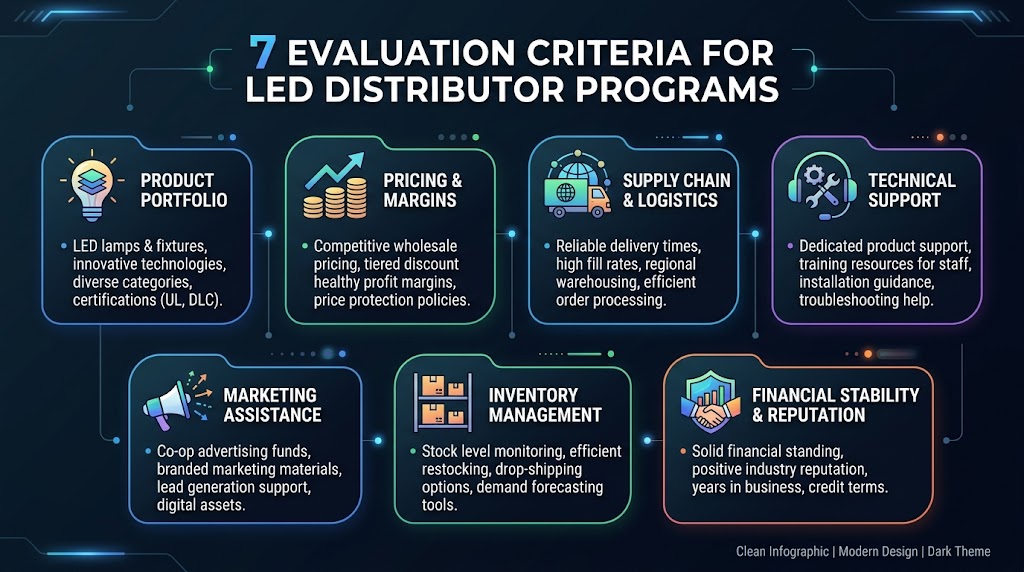
We assessed each trade program across seven criteria that electrical professionals care about when selecting a wholesale LED supply partner, weighting each factor by its measurable impact on project profitability and execution reliability during active bids.
- MAP enforcement (written policy vs. verbal promise vs. none)
- Territorial exclusivity (guaranteed, performance-based, or open market)
- Payment terms (Net 15, Net 30, COD, deposit requirements)
- Warranty coverage (length, claims process, replacement vs. credit)
- Product catalog depth (SKU count, fixture categories, certifications)
- Shipping speed (same-day, next-day local, standard lead times)
- Contractor support (training, spec assistance, co-op marketing, bid support)
Information was gathered from each company’s public program pages, distributor applications, and published terms as of April 2026. Where specific details were not publicly available, we note that in the program description.
LIBULBS Distributor Program

Program Highlights
LIBULBS (trade brand of Long Island Bulbs Inc.) runs an invitation-only wholesale distribution program for commercial LED lighting. The program centers on three written protections: MRP (Minimum Retail Pricing) enforcement across every product and channel, territorial exclusivity written into the trade account agreement, and bid protection on registered commercial projects.
The product catalog spans 444+ SKUs across three proprietary brands: BUILDERSPACK (panels, troffers, general commercial), and KINLIGHT (strips, vapor tights, specialty). Fixtures carry DLC and UL certifications with efficiency ratings up to 160 lumens per watt on round high bays.
Payment terms include Net 15 and Net 30 options subject to credit approval. Same-day shipping is available on in-stock items, with next-day delivery in the NYC metro area. Warranties run 5 years standard, with 7-year extended warranties available on pole lighting and select high bay products. Blind shipping and white-labeling are standard capabilities.
Why Contractors Choose LIBULBS
The combination of all three safeguards (MAP, territory, bid registration) in a single written agreement is rare in this market. Most competitors offer one or two of these features. LIBULBS structures every trade account with all three as default policy, not add-on options. Learn more about how to become a LIBULBS distributor.
During a March 2026 onboarding session at the Rehoboth Beach facility, our business development team walked a mid-Atlantic electrical contractor through the full trade agreement line by line. His first question: “What happens when someone undercuts my price on a live bid?” The answer was already in clause 4 of his agreement. That’s the kind of specificity contractors don’t get from a generic wholesale catalog.
Electricians working with LIBULBS supply partners report that pricing consistency is what keeps projects profitable. When you know a fixture price will hold throughout the bid and procurement cycle, you can quote tighter without risk.
Ready to protect your project margins? The LIBULBS trade account application takes about 3 minutes. Apply for a trade account.
Beyond LED Technology SOLED Program

Beyond LED Technology operates a distributor training and development initiative called the SOLED program. The program focuses on ongoing education through quarterly webinars, product briefings, and application-specific training sessions designed for electrical professionals.
Strengths: Strong U.S. inventory with fast nationwide fulfillment. The SOLED program provides structured training that newer distributors find valuable for building product knowledge. Their catalog covers panels, troffers, high bays, wall packs, and floodlights with DLC-certified options.
Considerations: Beyond LED does not publicly advertise written MAP enforcement or territorial exclusivity on their distributor page. Their program appears oriented toward open-market distribution with training support, rather than a protected-territory model. Contractors should ask directly about pricing protection policies before committing volume.
Best for: Contractors who value training and product education alongside their supply relationship, particularly those entering the commercial LED market for the first time.
Brilled Lighting Regional Partner Program

Brilled Lighting’s Regional Partner Program targets distributors and contractors with experience in lighting, electrical, construction, or facilities management. The program offers tiered wholesale pricing based on order volume, exclusive territories (negotiable), and customized training.
Strengths: The 10-year warranty is the longest in this comparison. Free sample fixtures and trial orders let contractors test products before committing to volume purchases. The program accommodates companies of all sizes, from single-state operators to multi-state distributors. Brilled claims a 24-hour response time on warranty claims.
Considerations: Payment terms require a 30% down payment on orders, with Net 30 on the remaining 70%. This is less flexible than full Net 30 terms. Direct manufacturing orders carry 30 to 45 day lead times, which can conflict with tight project schedules. Territory exclusivity is described as negotiable rather than guaranteed.
Best for: Contractors and distributors who prioritize long warranty coverage and are willing to accept longer lead times for direct manufacturing orders.
Aglare USA Distributor Program
Aglare USA offers a distributor program targeting electrical professionals interested in commercial and industrial LED products. Their program includes MAP enforcement and territorial protection, with a focus on the North American market.
Strengths: Aglare publicly advertises both MAP enforcement and territory protection as program features. Their product range covers commercial and industrial categories. The application process is straightforward and accessible through their website.
Considerations: Product catalog depth appears more limited than competitors with 400+ SKUs. Publicly available details on payment terms, shipping speed, and warranty specifics are sparse. Contractors should request detailed program documentation before committing.
Best for: Contractors seeking a smaller, more focused distributor partner with explicit MAP and territory commitments.
Amico Light Distributor Partnership
Amico Light structures its distributor partnerships through a six-step onboarding process: product understanding, initial contact, evaluation, partnership agreement, training, and ongoing feedback loops. Their catalog includes recessed downlights, flat panels, UFO high bays, and emergency lights.
Strengths: Published pricing visibility (downlights from $4.99, panels from $21.66, high bays from $28.70 per unit) helps contractors estimate project costs before applying. The structured onboarding process includes product knowledge training and marketing support. Amico mentions territorial exclusivity as available based on performance and commitment.
Considerations: Territorial exclusivity is performance-based, not guaranteed at sign-up. The evaluation process timeline is not publicly documented, which could delay onboarding. Minimum order quantities are not specified on public pages.
Best for: Price-sensitive contractors working on small-scale and light commercial projects where per-unit fixture cost is the primary decision factor.
Cooper Lighting Solutions MarketPro Program
Cooper Lighting Solutions (an Eaton company) operates the MarketPro program, providing access to top-selling lighting and controls products from industry-recognized brands. Cooper’s portfolio includes Halo, Metalux, Fail-Safe, and other established commercial and industrial lines.
Strengths: Brand recognition is the primary advantage. Specifying Cooper products on institutional and government projects carries weight with end customers and general contractors. The product portfolio is among the broadest in the industry, spanning commercial, industrial, outdoor, and controls categories. Established distribution network provides broad availability.
Considerations: Cooper products typically carry premium pricing compared to value-tier wholesale suppliers. Lead times can extend beyond what smaller, more agile distributors deliver. The MarketPro program is oriented toward established distributors rather than individual contractors looking to build a new supply relationship. Territory protection and MAP enforcement details are managed through regional representatives rather than published publicly.
Best for: Contractors bidding on institutional, government, and large commercial projects where brand specification carries significant weight with the end customer.
Side-by-Side Comparison Table

| Feature | LIBULBS | Beyond LED | Brilled | Aglare | Amico | Cooper |
|---|---|---|---|---|---|---|
| MAP Enforcement | Written (MRP policy) | Not publicly stated | Not publicly stated | Yes (advertised) | Not specified | Via regional reps |
| Territorial Exclusivity | Guaranteed (written) | Not publicly stated | Negotiable | Yes (advertised) | Performance-based | Via regional reps |
| Bid Protection | Yes (written) | Not publicly stated | Not specified | Not specified | Not specified | Not specified |
| Payment Terms | Net 15 / Net 30 | Not published | 30% down + Net 30 | Not published | Not published | Through distributor |
| Warranty | 5 yr (7 yr extended) | Varies by product | 10 years | Not published | Varies by product | Varies by brand |
| Same-Day Shipping | Yes (in-stock items) | Fast fulfillment | 30-45 day mfg orders | Not specified | Not specified | Through distribution |
| Product Catalog | 444+ SKUs | Broad commercial | Commercial/industrial | Commercial/industrial | Limited categories | Broadest in market |
| White Label/Blind Ship | Yes (standard) | Not specified | Drop-shipping available | Not specified | Not specified | Not applicable |
| Training/Support | Co-op funds, demos | SOLED quarterly training | Customized training | Basic support | Structured onboarding | Full technical support |
The comparison reveals that most programs excel in one or two areas but leave gaps in others. Only LIBULBS and Aglare publicly commit to both MAP enforcement and territorial exclusivity. Only LIBULBS adds bid protection as a written standard feature. Brilled leads on warranty length. Cooper leads on brand portfolio breadth. Choosing the right program depends on which factors matter most for your specific project mix.
How to Choose the Right Program for Your Contracting Business
The best LED lighting distributor program for your business depends on the types of projects you bid, the volume you move, and whether pricing protection or product breadth matters more for your margin structure. Here is how to think about the decision based on your contracting profile.
For High-Volume Commercial Project Work
If you regularly bid on warehouse retrofits, commercial office buildouts, or multi-site rollouts, prioritize suppliers with written MAP enforcement, bid protection, and same-day shipping. Pricing inconsistency on high-volume projects erodes margins quickly. LIBULBS and Aglare both offer the pricing protections this segment demands. LIBULBS adds same-day shipping on in-stock inventory, which matters when project timelines compress. Read our guide on what to look for in an LED lighting distributor for a more detailed evaluation framework.
For Regional and Light Commercial Work
Contractors focused on smaller commercial spaces, storefronts, and property management accounts may prioritize per-unit pricing and warranty length over geographic exclusivity. Amico’s published per-unit pricing gives cost visibility upfront. Brilled’s 10-year warranty provides a selling point when pitching long-term value to building owners. Both programs accommodate smaller-volume operations.
For Specialty or Niche Applications
If you specialize in institutional, government, or specification-driven projects, brand recognition on the fixture matters. Cooper Lighting’s MarketPro program provides access to brands that architects and engineers already specify. The premium pricing is offset by the reduced friction of using pre-approved products. For contractors serving cold storage, harsh environments, or high-security facilities, verify that the distributor stocks IP65-rated, emergency battery backup, and explosion-proof options.
For a broader framework on this decision, review our comparison of LED lighting distributor vs. direct manufacturer to understand which sourcing model fits your business structure.
Red Flags to Watch for in Any Distributor Program

Not every LED lighting trade program delivers what the sales pitch promises. Here’s what we’ve seen go wrong. Before committing volume to any supply partner, watch for these warning signs that indicate the arrangement will cost you more than it saves.
- Verbal MAP promises without written policy. If the supplier says they “enforce pricing” but can’t produce a written MAP or MRP policy document, assume they don’t enforce it. Verbal commitments disappear the moment a larger buyer requests a discount.
- No territorial boundaries defined in the agreement. “We generally respect territories” isn’t the same as a written exclusivity clause. Without defined geographic boundaries in your trade agreement, you have no recourse when another reseller enters your market.
- No bid protection process. Ask specifically: “If I register a project bid, will you block competing quotes from other distributors for the same project?” If the answer is vague, your bid pricing is exposed.
- Warranty claims result in credit notes only. Some suppliers issue credits toward future purchases instead of replacing defective products. This works if you maintain consistent volume but becomes a problem if you reduce orders or switch suppliers. Understand the claims process before your first warranty issue.
- Extended lead times with no local inventory. Suppliers who manufacture overseas on a per-order basis may quote 30 to 60 day lead times. That works for planned projects but fails on emergency retrofits and tight-deadline bids. Verify whether the supplier stocks inventory domestically.
Our top questions every LED lighting distributor should answer provides a full checklist you can bring to any initial supplier meeting.
Frequently Asked Questions
What is MAP pricing enforcement for LED lighting?
MAP stands for Minimum Advertised Price. It’s a manufacturer-imposed floor that prevents any reseller from listing a product below a specified amount online or in print. When enforced in writing, MAP stops the undercutting cycle that erodes wholesale channel profitability. LIBULBS calls their version MRP (Minimum Retail Pricing) and applies it to every SKU across every sales channel. For the full mechanics, read our guide on MAP protection and territory rights.
How does territorial exclusivity work in distributor programs?
A territorial exclusivity clause assigns a defined geographic region to one authorized reseller. No other partner in the supplier’s network can sell identical products within those boundaries. The FTC treats these arrangements as permissible under its rule-of-reason framework, provided competing brands remain available in the same market.
What payment terms should contractors expect from LED distributors?
Net 30 is the industry baseline for qualified trade accounts. LIBULBS also offers Net 15 for faster-cycling operations. Brilled takes a hybrid approach: 30% upfront, with the remaining 70% due 30 days after delivery. Always clarify whether credit terms start from day one or require a purchase track record before activation.
Can contractors work with multiple LED distributors simultaneously?
Absolutely. Most electricians carry two to four active supplier relationships to span different fixture categories, price tiers, and project scopes. Consolidating volume with a single partner often unlocks better pricing, bid registration priority, and faster warranty resolution. The tradeoff: broader product access vs. deeper partnership benefits.
What certifications should LED distributor products carry?
Commercial LED products should carry UL listing for safety, DLC or DLC Premium certification for energy efficiency and utility rebate eligibility, and FCC compliance for electromagnetic compatibility. DLC certification is particularly important because it qualifies end users for utility rebates that can offset 30% to 50% of fixture costs, making your bid more competitive. The U.S. Department of Energy provides additional guidance on LED lighting standards and certifications.
How does bid protection prevent undercutting on active projects?
You register a live project with your supplier, locking that job to your account. The supplier then declines to issue competing fixture quotes through other channels for the same facility. Without this mechanism, two separate resellers can quote identical products to the same building owner at different markups, forcing both margins down.
What profit margins do LED distributors typically offer contractors?
Gross margins on commercial fixture sales through wholesale channels typically range from 15% to 30%. Accounts protected by enforced pricing policies average around 24%, while those operating in overlapping open-market territories see that figure drop to roughly 11%. For a full financial breakdown, see our analysis of LED lighting distributor profit margins in 2026.