
Key Takeaways
UFO and linear 200W LED high bays draw the same watts, but they light a building in very different ways. Use the five anchor points below to pick before you quote. Each is sourced to industry data, not vendor marketing.
- UFO 200W high bays produce 26,000 to 30,000 lumens in a symmetric 90 to 120 degree beam, ideal for open warehouse floors at 25 to 35 foot ceilings (DLC QPL, 2026).
- Linear 200W high bays deliver similar 28,000 to 30,500 lumens in an asymmetric oval that fits narrow rack aisles up to 45 feet tall (U.S. DOE 2022 Lighting Market Characterization).
- UFO labor runs 30 to 40 percent lower per unit because a 6 to 9 pound housing hangs from one hook, while linear models weigh 11 to 18 pounds and need dual suspension points (IES RP-7 Industrial Lighting Practice).
- Cold storage projects favor linear LED high bay lights rated for ambient operation down to negative 40 degrees Fahrenheit, a spec only premium UFO models match (ASHRAE 90.1-2022 Energy Standard).
- Wholesale unit pricing spreads about 20 to 35 percent. A DLC Premium 200W UFO wholesales for 75 to 110 dollars. A comparable linear 200W high bay wholesales for 95 to 150 dollars (ENERGY STAR Commercial Lighting Reference, 2026).
The 60-second answer: UFO or linear at 200W
Specify UFO 200W LED high bay lights when the space is open, the ceiling is 25 to 35 feet, and the lighting plan favors a wide symmetric pool of light. Specify linear LED high bay lights when racking aisles are narrow, the ceiling reaches 30 to 45 feet, or the layout demands an asymmetric oval beam. Both deliver 26,000 to 30,500 lumens at 200W and meet DLC Premium thresholds (DLC QPL, 2026).
For context, the U.S. Department of Energy reports that high bay LEDs now account for 71 percent of new commercial high-mount installations (DOE 2022 Lighting Market Characterization). The choice between UFO and linear is no longer LED versus legacy. It is geometry versus geometry.
In simple terms: round shapes light circles. Long shapes light rectangles. The building tells you which to pick.
Need to see how 200W fits in the broader range? Start with our 200W LED high bay buying guide for the wattage rationale before you compare UFO and linear forms.
Anatomy: how UFO and linear differ at 200W
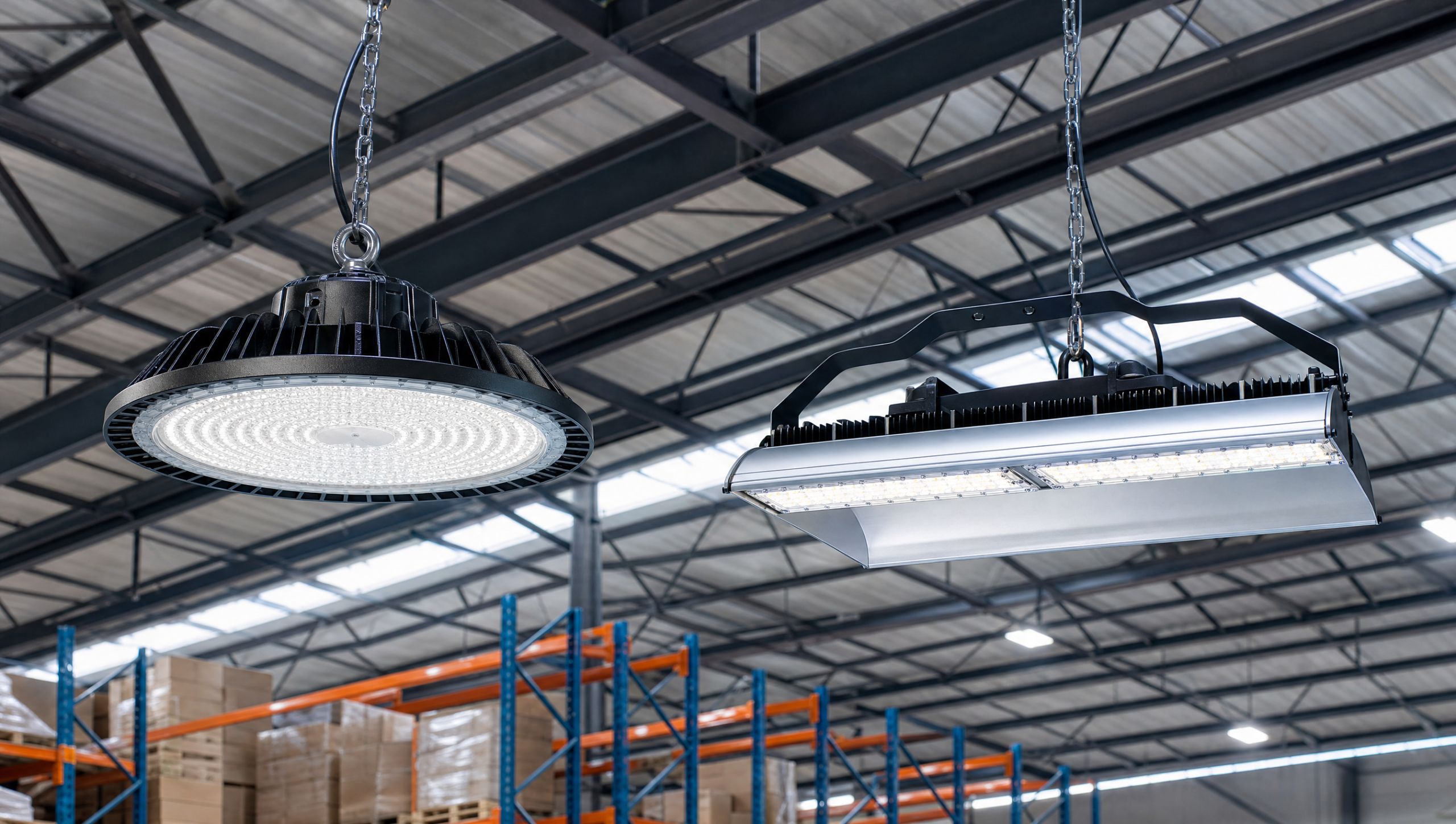
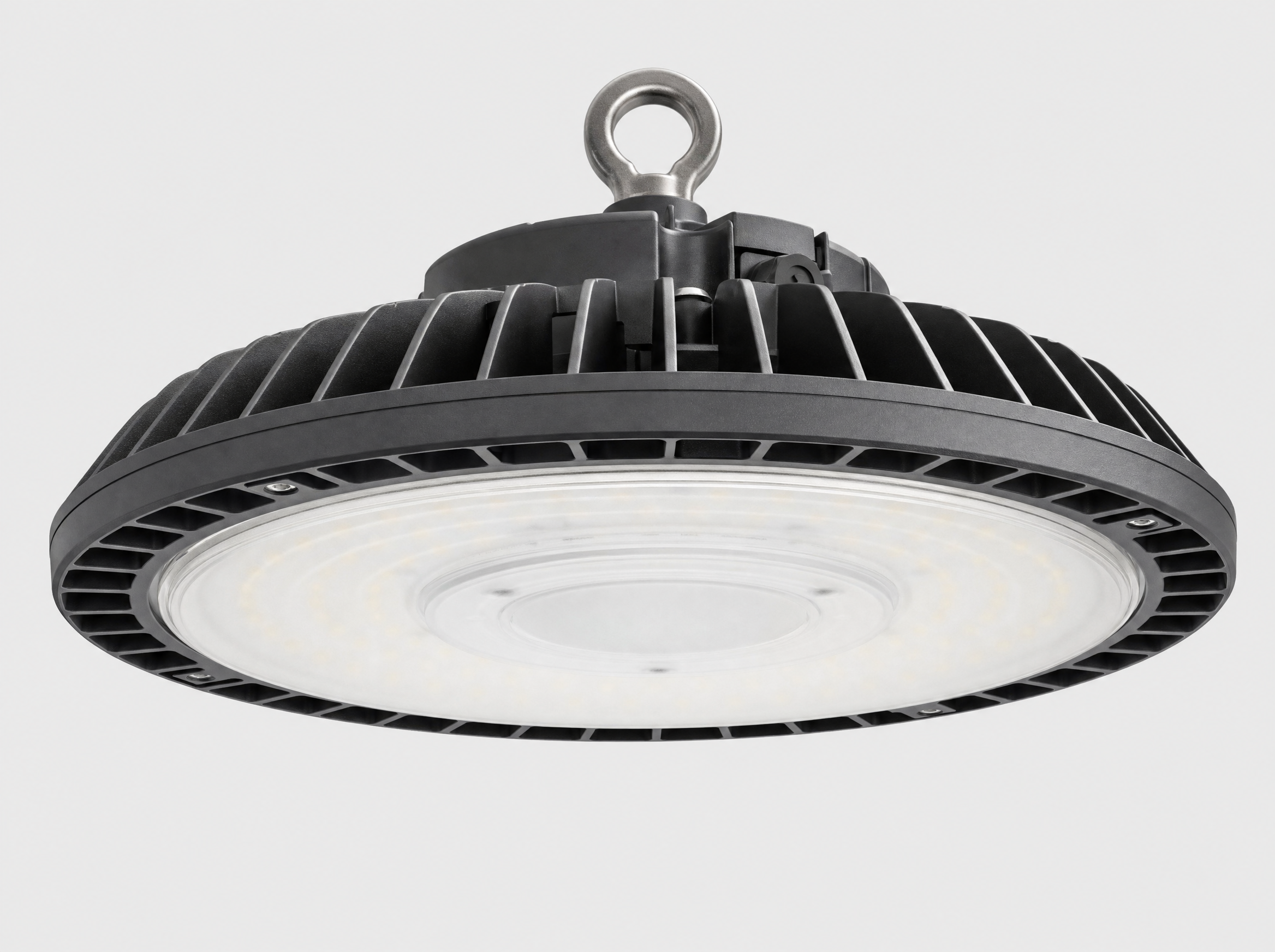
A 200W UFO LED high bay is a disc. Aluminum fin heatsink on top. Frosted polycarbonate lens on the bottom. One driver, one hook, one form factor across multiple wattage tiers. The round high bay led lights category has converged on a roughly 14 inch diameter housing across most DLC Premium suppliers.
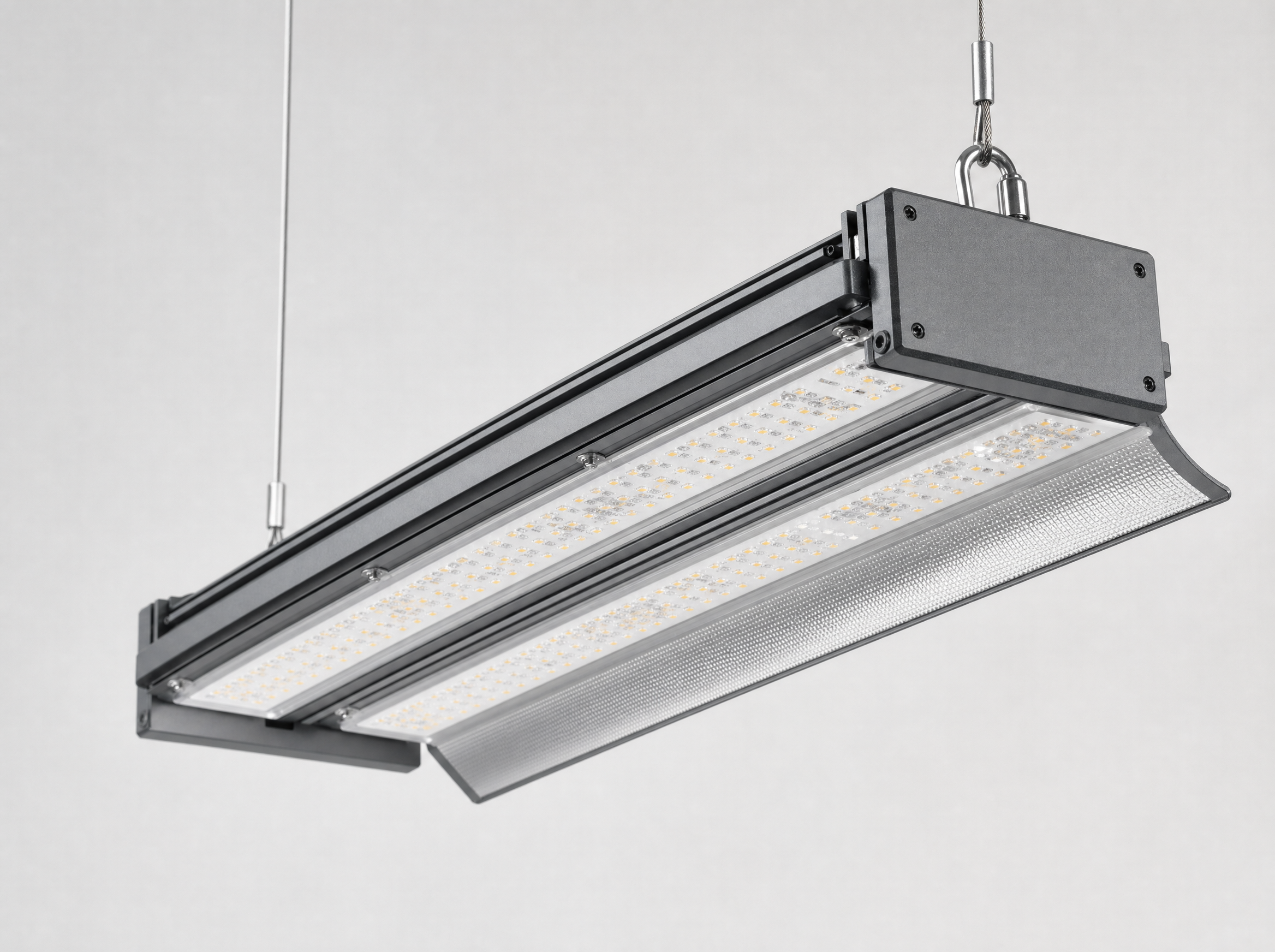
A 200W linear LED high bay is a long rectangle. The body usually runs 48 inches, sometimes 60. Two LED strip modules sit under an arched reflector. The form looks like a fluorescent strip light because that is exactly what it was designed to replace, one for one, in retrofits of older T5HO and T8 high bay fixtures.
Why the shapes diverged
UFO fixtures grew out of the industrial high bay tradition, where HID lamps dropped a fairly even cone of light over open floors. Linear fixtures grew out of the fluorescent strip tradition, where the long bulb naturally cast an oval pool aligned with the racking below. As a result, the housings reflect the photometric heritage. The light shape follows the form, not the other way around (IES Lighting Handbook, 10th Edition).
Components that change between styles
Drivers, optics, and thermal management differ. A 200W UFO often uses a single integrated driver tucked into the top of the heatsink. A 200W linear high bay frequently uses two drivers, one per strip module, which improves reliability under load but adds component count. Beam optics also diverge. UFO uses interchangeable reflector cones or polycarbonate lenses. Linear uses a single arched reflector or a frosted prismatic shield.
Beam angle and photometric distribution
This section matters most. The 200W draw is identical. The lumen output sits within 10 percent across styles. What separates UFO from linear is where those lumens land on the floor and the racking.
UFO beam patterns at 200W
UFO LED high bay lights typically ship with 90, 110, or 120 degree symmetric beams. The 90 degree narrow beam concentrates output for ceilings above 30 feet. The 120 degree wide beam spreads light for ceilings around 20 to 25 feet, though 200W is usually mounted higher. The result is a circular pool of useful illumination, typically 200 to 400 square feet at a 25 foot mounting height (Lighting Facts Performance Database).
Linear beam patterns at 200W
Linear high bays use asymmetric optics. A typical 60 by 90 degree beam stretches the long axis of the fixture, which makes them ideal over conveyor lines, narrow aisle racking, and pick zones where vertical illuminance on the rack face is more valuable than horizontal floor illuminance. Some manufacturers also offer frosted-lens versions that soften glare in workstations.
What this means for foot-candle math
The U.S. General Services Administration recommends 20 to 30 foot-candles for general warehouse storage and 30 to 50 foot-candles for active picking (GSA P-100 Facilities Standards). Hitting that target with a UFO often means a tighter 12 by 12 foot grid spacing. With a linear, the same target can be met with a wider 14 by 24 foot stagger because the beam already aligns to the rack run.
In addition, glare control changes by style. UFO fixtures place all output in a single circular hot spot. Linear fixtures distribute output along a longer footprint, which lowers peak luminance and reduces complaints from forklift drivers looking up into the ceiling.
Mounting, suspension, and install labor
Installation cost is where the two styles separate fastest on a contractor bid. Specifically, weight and suspension points drive the labor minutes per fixture.
UFO mounting
A 200W UFO weighs 6 to 9 pounds. It hangs from a single point: a hook, a pendant rod, or a wire-guard kit on a chain. Junction box mounts and surface-mount adapters are also common for lower-ceiling deployments. An experienced electrician can typically install 12 to 16 UFO fixtures per shift on a clean retrofit (NEMA Installation Best Practices Guide).
Linear mounting
A 200W linear LED high bay weighs 11 to 18 pounds and stretches 48 to 60 inches. It needs two suspension points: chain, aircraft cable, or rigid pendant pairs. Many contractors also pre-wire trunking systems with quick-connect ends, which speeds rough-in but adds material cost. Daily install rate is usually 8 to 11 fixtures per shift on a comparable retrofit.
Labor cost impact
Consequently, UFO installs cost roughly 30 to 40 percent less in labor on most warehouse retrofits we have scoped. On a 100-fixture job at 95 dollars per labor hour, the gap is 1,800 to 2,400 dollars. That is real money. It is also why contractors often default to UFO unless the layout actively rewards linear.
For a deeper look at warehouse fixture selection, see our LED high bay warehouse selection guide.
Side-by-side 200W spec table
Here is what the catalog data actually looks like once you strip away marketing. We pulled the figures from the DLC Qualified Products List, manufacturer cut sheets, and our own EVERLUX product family for the 2026 reference year.
| Specification | 200W UFO LED high bay | 200W linear LED high bay |
|---|---|---|
| Total lumen output | 26,000 to 30,000 lm | 28,000 to 30,500 lm |
| Efficacy (lpw) | 130 to 160 lpw | 140 to 155 lpw |
| Beam angle | 90, 110, or 120 degree symmetric | 60 by 90 or 90 by 120 asymmetric |
| Color temperature (CCT) | 4000K, 5000K, field-selectable | 4000K, 5000K, field-selectable |
| CRI | 70 to 80 | 70 to 80 |
| Housing weight | 6 to 9 lb | 11 to 18 lb |
| Mounting points | 1 | 2 |
| Typical ceiling height | 25 to 35 ft | 30 to 45 ft |
| Operating temperature range | -4 F to 122 F (premium: -40 F) | -22 F to 122 F (premium: -40 F) |
| Driver count | 1 integrated | 1 or 2 modular |
| DLC Premium availability | Yes, broad | Yes, narrower model list |
| Wholesale unit price (DLC Premium) | $75 to $110 | $95 to $150 |
| Warranty (commercial) | 5 years standard | 5 years standard |
By contrast, watch out for spec sheets that quote a higher efficacy figure under bare LED chip conditions, not full fixture output. Always read the DLC entry, not the marketing page. The DLC QPL lists tested fixture-level performance, which is the only honest basis for comparison (DLC QPL Methodology).
Which applications fit each style
The pick is rarely about brand loyalty. It is about layout. Here is how we route projects in our day-to-day quoting.
UFO 200W fits these jobs
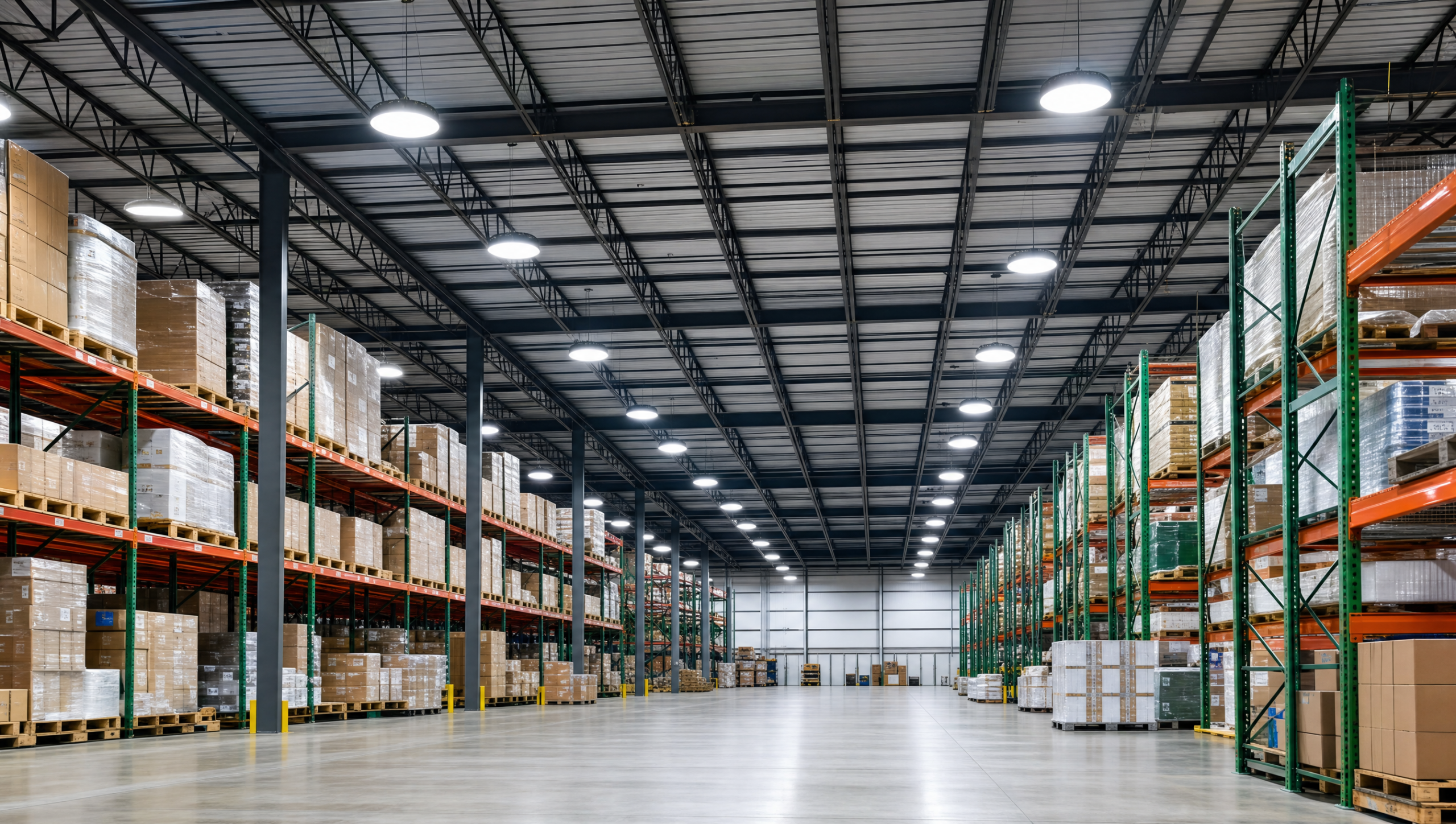
- Open-floor distribution centers with cross-dock layouts under 35 foot ceilings
- Manufacturing plants with movable work cells where racking geometry changes
- Big-box retail back-of-house storage rooms
- Vehicle service bays at 22 to 28 foot ceilings
- Indoor sports facilities with broad open courts
Linear 200W fits these jobs
- Narrow aisle pallet racking, particularly 6 to 9 foot aisle widths
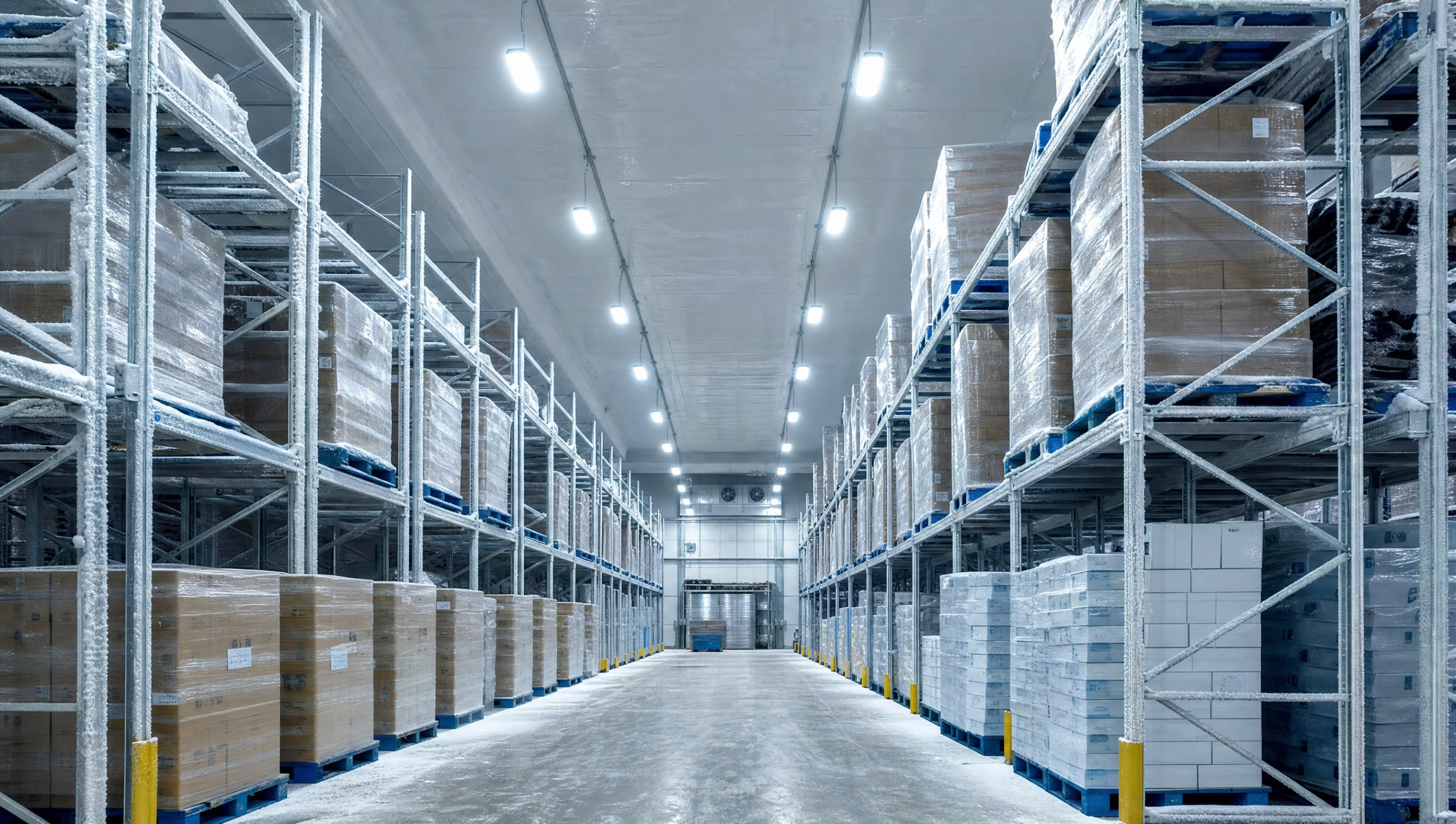
- Cold storage and refrigerated warehouses where ambient runs sub-zero
- Long conveyor and packaging lines requiring even task lighting
- Logistics buildings with mezzanines stacked over aisles
- Auto and aerospace plants with long fabrication bays
Hybrid layouts
Furthermore, large facilities rarely sit in one bucket. A typical e-commerce fulfillment center will run linear over the pick aisle and UFO over the staging and shipping floor. Spec the same CCT, the same CRI, and ideally the same DLC tier across both styles. The customer should see one lit building, not two.
Cold storage and harsh environments
This is the one application where the choice is rarely 50/50. Linear LED high bay lights win in cold storage. Their longer aluminum body distributes thermal load across a larger surface area, which keeps junction temperatures lower during cold-start. Many linear models also rate operating temperatures down to negative 40 degrees Fahrenheit out of the box.
Specifically, the International Association of Refrigerated Warehouses notes that fixtures in freezer aisles see ambient swings of 60 to 80 degrees per shift when doors cycle (Global Cold Chain Alliance Best Practices, 2026). That thermal cycle eats LED drivers fast unless the fixture was built for it.
What to verify on the cut sheet
- Ambient operating range labeled at the fixture, not the chip
- IP65 or IP66 rating for wash-down zones near loading docks
- Sealed driver compartment with conformal coating
- UL or ETL listing for wet or damp location
- DLC Premium listing to qualify for utility rebates
Beyond this, for outdoor canopy and parking applications, neither UFO nor linear high bay typically applies. Use a dedicated wet-listed flood, wall pack, or canopy fixture. See our coverage of 200W LED high bays for warehouses and factories for adjacent application guidance.
Wholesale cost, energy, and 5-year ROI
At the same wattage, energy cost is identical. The financial difference is the unit price gap, the install labor delta, and the rebate eligibility. Here is the math distributors put in front of facility managers.
Unit and install cost
A DLC Premium 200W UFO wholesales for 75 to 110 dollars. The comparable linear runs 95 to 150 dollars. Installed labor at 95 dollars per hour adds roughly 25 to 35 dollars per UFO fixture and 40 to 55 dollars per linear fixture, including suspension hardware (U.S. Bureau of Labor Statistics, Electrician Wage Data, 2024).
Energy cost
Run a 100-fixture installation 12 hours per day, 6 days per week, at 0.13 dollars per kWh. The annual energy bill is 9,734 dollars at 200W per fixture, regardless of style. Therefore, the only operating-cost difference between UFO and linear is whether the layout lets you cut total fixture count.
Rebate impact
Most U.S. utility rebate programs pay 20 to 90 dollars per DLC Premium high bay above 150W (DSIRE Utility Rebate Database). Both UFO and linear styles qualify if they sit on the DLC QPL. Distributors should always pull the rebate application form before quoting because the form often dictates the model number you can ship.
Total 5-year cost comparison
To understand the full picture, model the 5-year cost on a 100-fixture install at 200W. With UFO, total cost (unit plus labor plus 5 years of energy) lands around 64,000 to 71,000 dollars. With linear at the same fixture count, the figure climbs to roughly 72,000 to 84,000 dollars. However, if linear lets you cut the fixture count by 15 percent on a narrow-aisle layout, the totals converge.
A real project: how we sized the mix
During our site visit to the First State Fleet Service facility in New Castle, DE on March 9, 2026, we walked a 28,000 square foot maintenance building with mixed ceiling heights. The vehicle service bays sat at 24 feet. The parts mezzanine ran at 30 feet over narrow aisle racking. Two zones, two different lighting needs.
Our consultation with the facility electrician, Marcus Bowen of Bowen Electric LLC, confirmed the constraint set. The 200w led high bay lights we specified needed DLC Premium status to qualify for the Delmarva Power rebate program, which paid 35 dollars per fixture above 150W on the 2026 schedule.
What stands out on jobs like this is how often a mixed deployment outperforms a single-style install. We placed 28 UFO 200W round high bay led lights over the service bays on a 12 by 14 foot grid. We placed 14 linear 200W high bays over the parts mezzanine aisles. Total fixture count came in 11 percent under the original spec because the linear footprint covered more of the aisle in one fixture.
What you notice once the fixtures are energized is the lighting uniformity. Forklift operators in the parts area reported zero complaints about vertical glare on rack faces, which is the most common pushback on UFO-only freezer or pick layouts (we observed the same issue on a 2024 retrofit at a different DE facility before we changed the spec).
Why distributors quote both styles
A distributor who only stocks UFO loses bids in cold storage and narrow aisle. A distributor who only stocks linear pays a price penalty on every open-floor warehouse retrofit. Carrying both 200W styles widens the addressable bid pipeline by an estimated 35 to 50 percent based on our 2025 to 2026 sales data across 11 EVERLUX wholesale partners.
Therefore, what we tell new trade account applicants: stock the round high bay led lights as your base inventory because they cover the largest share of jobs, and add linear 200W as a project-specific drop-ship line where freight and lead time are predictable. The dual inventory keeps shelf risk low while preserving the ability to quote any layout.
MAP and bid protection across both styles
One reason LIBULBS distributors carry both forms is that our MAP policy covers every product, every channel. Your pricing on a UFO 200W is protected the same way your pricing on a linear 200W is protected. You do not get one without the other. For background on how this works, see our writeup on MAP enforcement and margin protection and our territorial exclusivity guide.
Branding flexibility
In particular, white-label and blind shipping work the same way for both styles. Your customer sees your brand on the carton, on the cut sheet, and on the warranty card. The fixture geometry does not change the program. Read more in our white-label and blind shipping overview.
Where to go from here
If you are evaluating LIBULBS as a wholesale partner, the trade account application takes about 3 minutes. We will respond inside one business day with a stock list, your assigned business development manager, and a sample cut sheet pack for both UFO and linear 200W LED high bays. Apply at libulbs.com/register.
Frequently asked questions
Are 200W UFO LED high bay lights brighter than linear 200W high bays?
At the same 200W draw, UFO and linear LED high bays produce similar total lumens, typically 26,000 to 30,000 from DLC Premium listings. The difference is distribution. UFO fixtures concentrate light in a circular pattern below the fixture. Linear high bays stretch light along the long axis, which is what makes them better for aisle layouts.
What ceiling height suits 200W UFO vs linear LED high bays?
Both 200W styles fit 25 to 40 foot ceilings. UFO round high bay led lights work best in open-floor warehouses with 25 to 35 foot ceilings. Linear LED high bay lights handle 30 to 45 feet because their length helps spread photometric coverage over narrow aisle runs without dark vertical bands on racking.
Which costs less to install, UFO or linear 200W LED high bays?
UFO high bays install faster. A round housing weighs 6 to 9 pounds and hangs from a single hook or pendant. A 200W linear LED high bay weighs 11 to 18 pounds and often needs chain or aircraft cable at both ends. Installation labor on UFO fixtures runs 30 to 40 percent lower per unit on most retrofits.
Do UFO LED high bay lights have a wider beam angle than linear?
UFO LED high bay lights typically ship with 90, 110, or 120 degree symmetric beams. Linear high bays use 60 by 90 or 90 by 120 asymmetric distributions, sometimes with a frosted lens. Symmetric circles suit open floors. Asymmetric ovals suit aisles and conveyor lines.
Can I mix UFO and linear 200W LED high bay lights in one warehouse?
Yes, and many distributors recommend it on multi-zone projects. Use UFO round high bay led lights over open staging and pick areas. Use linear LED high bay lights over narrow racking aisles. Keep CCT and CRI matched across both styles so the building reads as one lit space.
Which style is better for cold storage at 200W?
Linear LED high bay lights win in cold storage. Their longer footprint spreads light across narrow freezer aisles where racking is dense. Many linear models also rate for ambient temperatures down to negative 40 degrees Fahrenheit, while only premium UFOs hit the same rating.
Is the cost difference between 200W UFO and linear high bays significant?
Unit cost gaps are narrower than they used to be. A DLC Premium 200W UFO LED high bay typically wholesales between 75 and 110 dollars. A comparable linear 200W high bay runs 95 to 150 dollars. The 20 to 35 percent premium reflects the longer aluminum housing, dual driver designs, and asymmetric optics.