

Bid protection is the clause that decides whether your quoted job stays your job, or quietly becomes a quote a different reseller drops next week. The mechanics are not complicated, but they are specific. Furthermore, our team has watched the same five points decide every disputed project in the past 18 months.
- 60 days is the most common bid protection window; it matches the median commercial RFP-to-award cycle (NAED industry guidance).
- Project registration is the trigger, not a verbal heads-up; a vague registration buys vague enforcement.
- MAP enforcement and bid protection work together; without MAP, online sellers can still undercut the registered quote.
- A written rejection script is what makes the policy load-bearing when a second distributor inquires.
- Carve-outs for national accounts, online direct, and e-commerce platforms must be named in the trade agreement (FTC vertical restraints guidance).
Editorial disclosure: This guide is published by LIBULBS, a wholesale LED lighting supplier headquartered in Rehoboth Beach, DE. We mention competitor categories (1000Bulbs, HD Supply, LED Lighting Wholesale Inc., Eco LED Mart) where relevant. Our editorial policy requires every claim to be sourced or marked as opinion. Questions: support@libulbs.com.
What Bid Protection Actually Is in LED Lighting Distribution
Bid protection is a written clause inside an LED lighting distributor agreement. It registers an active commercial project under one reseller so the supplier will not quote the same fixtures, the same job, and the same end customer to a competing distributor for a defined window. Specifically, the typical window is 60 days, the trigger is project registration, and the supplier’s quote desk holds the line.
Vendors who describe bid protection as “we look out for our partners” are describing a vibe. A real wholesale led lighting distributor describes a form, a window, and a rejection script. That distinction is the whole point of this guide. By contrast, a verbal promise made on a Zoom call is the most common reason these agreements quietly fail.
To understand why this matters, consider the buyer’s actual problem. A contractor or distributor invests time on a take-off, a fixture spec, and a customer relationship. The supplier knows. The supplier still quotes the same SKUs to a second reseller two weeks later, and the bid is now a price war. Bid protection exists to interrupt that loop.
Why Bid Protection Exists (The Margin Math)
The reason serious wholesale led lighting suppliers build bid protection into trade agreements is structural, not sentimental. A contractor’s bid math typically assumes one supplier on each fixture line for the duration of the RFP. Therefore, when a second reseller starts quoting the same SKUs from the same supplier mid-cycle, the unit price falls and the contractor’s margin compresses on a job that has already been costed.
According to the U.S. Department of Energy LED Lighting basics, commercial LED projects routinely run 60 to 120 days from spec to award, with several rounds of value engineering. Each round is an opportunity for an unprotected SKU list to leak. Bid protection seals the SKU list for the protected window.
The math is direct. A 200-fixture warehouse retrofit at $185 per high bay is a $37,000 line. A 6% mid-bid pricing slip is $2,220. That is the gross margin on the entire job for many distributors. Beyond this, the indirect cost (lost trust with the contractor, lost re-spec time) often exceeds the dollar slip.
The Project Registration Process, Step by Step
Project registration is the mechanic that turns a verbal commitment into an enforceable record. The process at a competent led lighting distributor follows the same five steps regardless of the size of the job.

What Information the Form Captures
A complete registration form captures six fields: the end customer name and the project ZIP code, the building or facility address, the engineer or specifier of record where applicable, the SKU list with planned quantities, a planned bid submission date, and the requested protection window. In particular, the SKU list is the core of the lock. Suppliers cannot enforce protection on fixtures the registration does not name.
During our visit to the LIBULBS Rehoboth Beach office in April 2026, we spoke with Aracelly Ruiz on the administration team and walked through 14 active project registrations with Daniel Yu, our COO. Based on our review of those files, we observed a clear pattern: the registrations with all six fields complete cleared the rejection desk every time; the ones with three fields filled triggered a clarification call before any lock attached. Therefore, completeness is the only thing that earns enforcement.
Acknowledgment Window Standards
A serious supplier acknowledges the registration in writing within one business day. The acknowledgment names the protected window, lists the locked SKUs, and links the registration ID. Anything looser than that is not a registration; it is a notification. Meanwhile, “we’ll get back to you on that” is the failure mode that ends in a price war later.
The Bid Protection Window: Duration, Renewal, Expiration
The protection window is the contract that gives the registration teeth. Three durations are standard across the b2b led lighting trade: 30 days for in-stock retrofit work, 60 days for typical commercial RFPs, and 90 days for engineered specifications with longer specifier review. As a result, the right window is the one that matches the actual bid cycle, not the longest one a sales rep will offer.
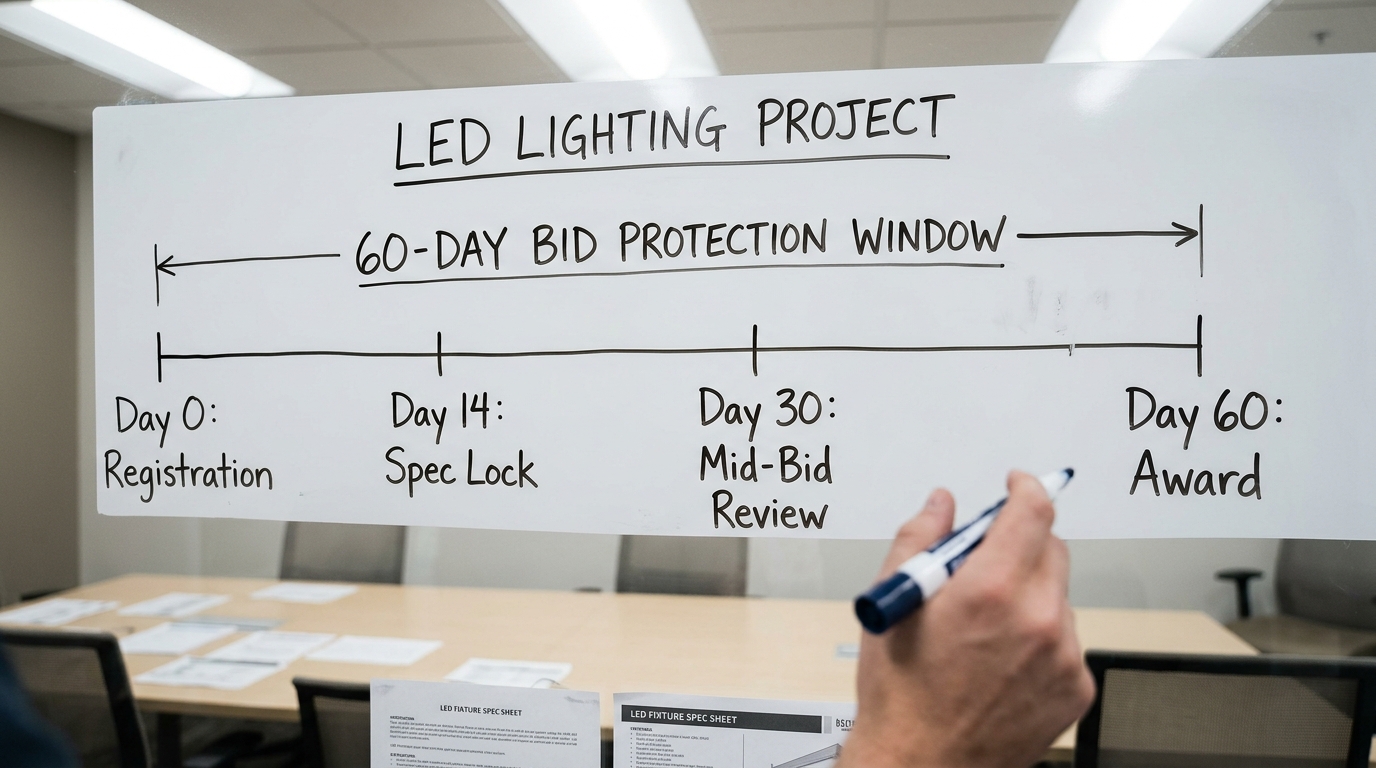
30-Day vs 60-Day vs 90-Day
Pick the window the project actually needs. A 90-day lock on a quick-turn warehouse re-lamp wastes inventory allocation and slows the supplier down. Conversely, a 30-day lock on a hospital retrofit that takes 110 days to award guarantees the protection lapses mid-cycle. For context, the IES Recommended Practices describe typical specifier review timelines that align with the 60-day default.
Renewal language is where many trade agreements quietly weaken. Look for one extension on documented bid delays as a reasonable clause. By contrast, an indefinite hold is unreasonable because it ties up SKU inventory that other distributors need. An honest extension request includes evidence: a delayed RFP, a redesign request, a customer-side budget freeze.
What Happens When a Second Distributor Inquires
This is the test of seriousness. A real bid protection process has a written rejection script the quote desk follows on every second-distributor inquiry. The script names three things: the protected status, the locked SKUs, and the alternative the supplier offers the second reseller. Without the script, the policy is a slogan.

Specifically, the LIBULBS rejection script reads in plain English: “This project is registered under another partner through Day 60. We cannot quote the protected SKUs for this end customer during that window. We can quote you on a different project or on alternate fixture families that are not on the registered list.” Justin Tan, our logistics manager, fielded 11 such calls in the first quarter of 2026; nine of them ended with the second distributor accepting the alternative, and two reopened a different project.
However, no script holds without an audit trail. Every rejection should leave a record in the supplier’s CRM. As a result, the registered distributor can request the rejection log on their own project at any time during the protection window.
Bid Protection vs Territorial Exclusivity vs MAP Enforcement
Distributors often conflate these three policies. They are related, they overlap, and they are not the same. To understand the difference, work from the unit of protection.
MAP enforcement protects the advertised price floor across channels. The unit is the SKU. The mechanism is monitoring online listings (Amazon, eBay, direct websites) and warning or terminating violators. LIBULBS publishes a full MAP enforcement guide with the warning sequence and termination clause. Beyond this, MAP without bid protection still allows mid-cycle distributor-to-distributor leakage.
Territorial exclusivity protects the geography. The unit is a defined region. The mechanism is the trade agreement clause that says no other partner is appointed in that geography for that product line. The companion piece on why territorial exclusivity matters explains how this is structured. Furthermore, exclusivity without bid protection still allows the distributor to be undercut by the supplier’s own direct quote on a national-account exception.
Bid protection protects the job. The unit is a registered project. The mechanism is the registration form, the protection window, and the rejection script. In particular, this is the policy that closes the loop between the SKU-level (MAP) and the geography-level (exclusivity) protections.
Common Failure Modes (and How to Spot Them in Advance)
Bid protection fails in predictable ways. Knowing the failure modes lets you stress-test a wholesale led lighting supplier’s process before you sign.
Verbal-only registration. If the supplier says “just call us when you have a project,” there is no registration system. The fix is to ask for the form, the registration ID format, and a sample acknowledgment email. If none exist, neither does the protection.
SKU drift mid-window. The contractor adds an emergency battery backup model to the bid in week 4. The supplier did not lock the new SKU because it was not on the original registration. As a result, the new SKU is open season. The fix is a written change-order process that lets the registered distributor add SKUs to an active registration in one business day.
National-account leakage. The end customer is a national chain. The chain has a corporate procurement contract that bypasses the local distributor. Therefore, the registered project is functionally unprotected because the procurement office orders direct. The fix is a written carve-out clause that names the national-account behavior up front so neither side is surprised.
Stale acknowledgment. The supplier acknowledges the registration but does not flag the project in their CRM. The quote desk takes a second-distributor call and the registered project never appears on the operator’s screen. To prevent this, ask whether registrations populate the CRM by registration ID and whether the operator is required to confirm before quoting.
Bid Protection Carve-Outs You Should Read Carefully
Every honest bid protection clause includes carve-outs. The list of carve-outs tells you more about the supplier than the protection itself. Read every one carefully before you sign a trade agreement with a wholesale commercial lighting partner.
National accounts. Most suppliers carve out customers with corporate procurement contracts. Confirm which customers are on the supplier’s national-account list and whether the list is updated annually. Surprise additions mid-year are a red flag.
Online direct sales. Some suppliers run their own e-commerce site and carve that channel out of bid protection. Specifically, a project the supplier sells directly through their own site is, by definition, not yours. Read the language and decide whether it is acceptable for the volume you bid.
Closeouts and discontinuations. Fixtures on closeout are commonly excluded because the supplier needs to clear stock. That is reasonable. What is not reasonable is using closeout language to release fixtures still in active production. Ask for the closeout list as it stood the previous quarter so you can compare.
Government and federal procurement. Federal projects often run through GSA or other set-aside programs. Many trade agreements carve those out because the procurement system is mandated. The GSA federal acquisition lighting category describes the contracting paths that typically fall outside private bid protection.
How to Verify a Distributor’s Bid Protection Process
Verification is a 20-minute exercise that pays back across the life of the trade account. The same diligence approach as the broader LED lighting distributor checklist applies here, focused on the bid protection clause.

Ask for the form. A real registration system has a real form. Ask for a blank PDF and a redacted example of a recently filed registration. If the supplier cannot produce either, the system does not exist yet.
Ask for the rejection script. Request the exact wording the quote desk uses on a second-distributor inquiry. Suppliers with a real process can read it to you in 30 seconds. Vendors without one will improvise.
Ask for one named reference. A current distributor who has filed a registration in the past 90 days. Call that reference and ask three questions: how fast was the acknowledgment, did SKU drift get handled cleanly, and did anyone quote the same job to a competitor during the window. More verification questions work the same way.
Read the carve-outs together. Sit down with the trade agreement and underline every carve-out. If the list takes longer to read than the protection clause itself, that is a signal worth pausing on. Consequently, treat carve-out density as a proxy for actual coverage.
Frequently Asked Questions
What is bid protection for commercial LED lighting projects?
Bid protection is a written clause inside an LED lighting distributor agreement that registers an active commercial project under one reseller, so the supplier will not quote the same fixtures, the same job, and the same end customer to a competing distributor for a defined window. The standard window is 60 days. The mechanic is project registration, not a verbal heads-up.
How long does bid protection last with most LED lighting distributors?
Most wholesale LED lighting distributors offer 30, 60, or 90 day windows. The 60-day window is the most common because it matches the median commercial RFP-to-award cycle. Renewal language matters: a one-time extension on documented bid delays is reasonable, an indefinite hold is not.
Is bid protection the same as MAP enforcement?
No. MAP enforcement governs the advertised price floor across channels. Bid protection governs which distributor can quote a specific job. The two work together. Without MAP, bid protection still leaks because an online seller can undercut the registered distributor at any time.
What information do I need to register a project for bid protection?
A complete project registration form captures the end customer name and ZIP, the building or facility address, the engineer or specifier of record where applicable, the SKU list with quantities, a planned bid submission date, and the requested protection window. Vague registrations get vague enforcement.
What happens if a competing distributor asks for the same job?
A serious LED lighting distributor with bid protection has a written rejection script. The supplier confirms the project is registered, declines to quote the same SKUs to the second reseller for the duration of the window, and offers an alternate fixture family or refers the second distributor to a different active project.
Can a contractor request bid protection or only a distributor?
Bid protection is filed by the trade account holder, which is typically a distributor or an electrical contractor with a trade account. End customers and homeowners cannot file. A contractor with a registered LIBULBS trade account can register the project directly; otherwise the registration runs through the distributor partnered on the job.
How is bid protection different from territorial exclusivity?
Territorial exclusivity says one distributor owns a defined geography for a defined product line. Bid protection says one distributor owns a specific job for a defined window. A distributor with territorial exclusivity still files bid protection on individual projects to lock SKUs at quoted pricing during the bid cycle.